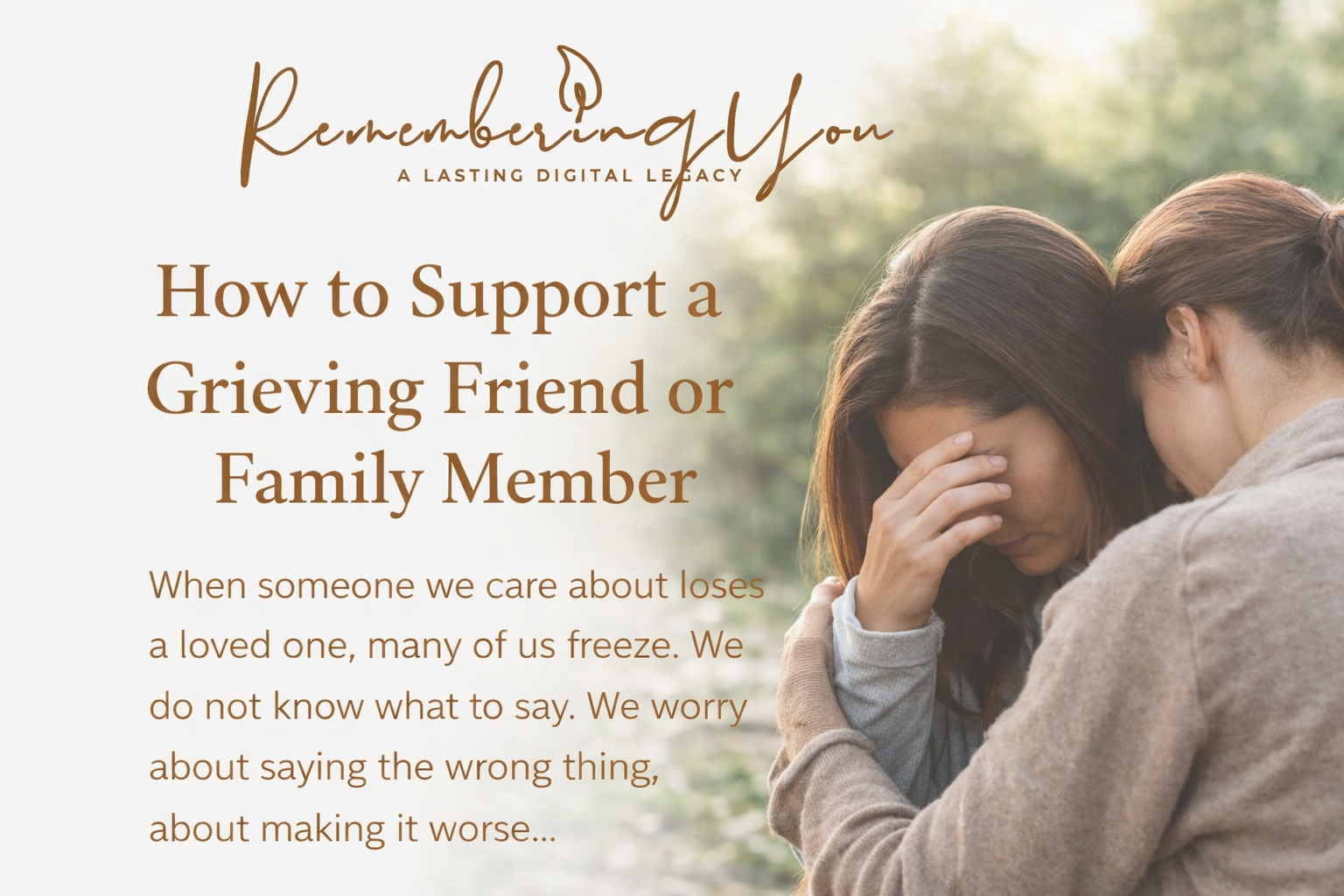
When someone we care about loses a loved one, many of us freeze. We do not know what to say. We worry about saying the wrong thing, about making it worse, about intruding on private pain. And so, too often, we say nothing. We stay away. We convince ourselves that the grieving person needs space, or that our presence would be intrusive, or that we will reach out when things have settled — which, of course, they never quite do.
Here is the truth about grief support: showing up — in any form, with any imperfect words — is almost always better than staying away. The fear of doing it wrong keeps many people from doing it at all. But the grieving person, in their isolation and loss, notices who showed up and who did not. Presence, however awkward, is the foundation of grief support.
The Most Important Principle: Show Up
Before any specific advice, one principle stands above all others: be present. The form that presence takes will vary — a visit, a phone call, a handwritten note, a text message that asks nothing in return. What matters is the act of reaching out, the signal that says: I know what you are going through, I am not afraid of your grief, and I am here.
Many people avoid those who are grieving not out of indifference but out of their own discomfort with death and loss. Grief reminds us of our own mortality, our own vulnerability. Sitting with a grieving person means sitting with those realities. It is uncomfortable. Do it anyway. The discomfort you feel is small compared to the isolation the grieving person feels when people they care about disappear at the very moment they are most needed.
What to Say: Helpful Phrases
The anxiety about finding the right words is understandable but often overstated. A grieving person does not need eloquence. They need acknowledgement — the simple recognition that their loss is real, significant, and felt by others. Here are phrases that genuinely help:
- "I'm so sorry for your loss." — Simple, sincere, and never wrong.
- "I've been thinking of you." — This tells the person they are not forgotten.
- "I don't have the right words, but I want you to know I'm here." — Honesty about your own limits is far better than false confidence.
- "Tell me about [the person who died]." — An invitation to share memories is one of the most loving things you can offer. Most grieving people are desperate to talk about the person they have lost, and many people around them are too uncomfortable to invite that conversation.
- "I miss him too." — If it is true, say it. Shared grief is still connection.
- "You don't have to talk. I'm just here." — Sometimes presence without conversation is exactly what is needed.
What Not to Say: Phrases That Often Cause Pain
Some phrases, however well-intentioned, can cause unexpected pain. These are among the most commonly regretted:
- "They're in a better place." — This may feel dismissive of the pain of the loss, and may not reflect the beliefs of the grieving person.
- "At least they had a long life." — At least is almost always a phrase to avoid. It minimises the grief by suggesting a silver lining the person may not be ready to see.
- "I know how you feel." — Unless you have experienced an identical loss, this is rarely true — and the grieving person knows it.
- "Everything happens for a reason." — This can feel deeply invalidating to someone in acute grief.
- "You need to be strong for the children." — Telling a grieving person to suppress their grief is never helpful, however loving the intention.
- "Let me know if there's anything I can do." — Well-meant but often unhelpful, because a person in grief rarely has the energy or clarity to identify and articulate their needs. Offer something specific instead.
Practical Ways to Help
Actions often speak louder than words in the context of grief. Practical support, offered without expectation of gratitude and without requiring the grieving person to ask, is one of the most meaningful contributions you can make.
In the Immediate Aftermath
- Cook or organise meals — the kitchen is often the last thing a grieving person can engage with. Dropping off a meal, organising a meal rota with other friends and family, or ordering a food delivery removes one daily decision from an already overwhelming time.
- Handle specific practical tasks — grocery shopping, collecting prescriptions, taking children to school, walking the dog. Identify a single specific task you can reliably handle and offer to take it on.
- Help with the administrative burden — if you have administrative skills, offer to help with the paperwork that accumulates after a death. Return calls to utility companies, help draft announcements, assist with the death registration process.
- Help with the memorial — offer to help create and populate the online memorial page. Gathering photographs, writing biographical details, and building the life timeline are tasks that are easier with help — and the result is precious.
In the Weeks and Months After
- Check in regularly — not just in the first week but in the weeks and months that follow. Grief does not end at the funeral. The third month, the first Christmas, the first birthday, the first anniversary — these are often the hardest moments, precisely because the immediate community support has typically dissipated by then.
- Remember significant dates — a text message on the birthday of the person who has died, on the anniversary of the passing, at Christmas, costs almost nothing and means a great deal.
- Invite normalcy — invite the grieving person to ordinary social events without pressure. They may say no many times before they are ready to say yes. Keep asking. Let them know the invitation stands whenever they are ready.
- Listen without trying to fix — grief cannot be fixed. It can only be carried. Your role as a supporter is not to accelerate the grieving person's recovery but to accompany them through the process without trying to redirect, minimise, or explain it.
The Long View: Sustained Support
The most common failure of grief support is its brevity. The immediate aftermath of a death brings an outpouring of support — flowers, cards, visits, meals. Six weeks later, most of that has evaporated. And yet the grieving person is, if anything, more in need of support than they were in the first week, when the adrenaline of crisis was still carrying them through.
Research on bereavement consistently shows that meaningful support over the medium and long term — the friend who still calls three months later, the colleague who remembers the anniversary two years on, the neighbour who still drops by without being asked — makes a significant difference to outcomes for bereaved people. Be that person, if you can.
Grief is love with nowhere to go. The support you offer is a way of giving that love a direction — of saying: the person they loved mattered, and so do they. There is no more important thing you can offer someone in grief than your sustained, imperfect, genuine presence.