Staring at a blank sympathy card is harder than it should be. You want to say something meaningful, but every phrase you type feels either too formal or too casual for the moment. That blank space matters more than you think, since your words are often what a grieving family rereads weeks after the flowers have wilted.
This list gives you 75 messages of sympathy you can use as they are or adapt to fit your relationship with the person who died. You'll find options for a coworker, a close friend, a grieving parent, or someone who lost a pet and may want a free pet memorial website later, plus short lines for when you barely know what to say and longer notes for when you knew the person well. Every entry works as sympathy card wording you can copy directly, no rewriting required.
Below, you'll find messages grouped by situation, so you can jump straight to the ones that match your relationship with the grieving person. And if you're helping a family think beyond the card itself, a digital memorial page on Remembering You lets loved ones add photos, stories, and a guestbook where messages like these can live on long after the service ends.
1. Short and general sympathy messages
Sometimes you don't know the family well, or you're signing a card at work alongside a dozen coworkers, and you just need a few honest lines that won't feel out of place. Short sympathy messages work best here because they respect the reader's time without sounding cold or rushed. A brief, sincere line beats a long paragraph that tries too hard to say the right thing.
A short, honest sentence often comforts more than a long, searching one.
Example messages
These general sympathy card messages suit almost any relationship, from a distant relative to a neighbor you rarely see. Pick one as-is or use it as a starting point:
- "I'm so sorry for your loss. Thinking of you during this difficult time."
- "My deepest sympathy to you and your family."
- "Sending you love and strength as you navigate this loss."
- "There are no words, just know I'm thinking of you."
- "Wishing you comfort and peace in the days ahead."
- "My heart goes out to you. I'm here if you need anything."
- "I'm holding you in my thoughts during this hard time."
- "With heartfelt condolences to you and your loved ones."
- "I don't have the right words, but I want you to know I care."
- "Sending quiet strength your way today and every day."
A meaningful gesture to accompany it
A card alone can feel small next to a loss this big, so pair your words of sympathy with something practical. Drop off a meal, send a grocery gift card, or simply text "thinking of you, no need to reply" a week after the funeral when other messages have stopped coming. Grief doesn't end when the visitors leave, and a short check-in later often means more than the card itself.
If you're close enough to the family, mention that a lasting tribute exists beyond the paper card. Suggest they look into how to create an online memorial page, where they can post the same kind of message alongside photos and a shared guestbook. It gives your short note a second home, one that friends and family scattered across the country can visit anytime, not just during the week of the service.
2. Sympathy messages for the loss of a parent
Losing a parent reshapes someone's whole sense of home, even for adults who haven't lived with mom or dad in decades. Messages for sympathy in this category should acknowledge that a parent is often a person's first teacher, first comfort, and longest relationship, so generic lines can fall flat here. Naming something specific, even briefly, shows you understand the size of what's gone.
Losing a parent means losing your first home, wherever you've lived since.
Example messages
Use these sympathy messages for cards when writing to someone who has lost their mother or father, adjusting pronouns and details as needed:
- "Your dad shaped so much of who you are. I'm so sorry for this loss."
- "Your mom's kindness touched everyone who knew her. Sending you comfort and love."
- "Losing a parent leaves a space nothing else can fill. I'm thinking of you."
- "I'm grateful I got to know your father. His memory will stay with all of us."
- "Your mother raised someone I'm proud to call my friend. That says everything about her."
- "May the memories of your parent's love bring you comfort in the months ahead."
- "I know how close you were to your dad. Please lean on me whenever you need to."
A meaningful gesture to accompany it
Offer to help sort through old photographs, since sympathy cards and messages rarely cover the practical grief of going through a parent's belongings. Sitting with someone during that task, or simply bringing coffee while they do it, often matters more than any card. Suggesting creative photo tribute ideas or a parent tribute page later, once the sorting is done, gives those photos a permanent home rather than a box in the attic.
3. Sympathy messages for the loss of a spouse or partner
When someone loses a spouse, they lose their daily witness, the person who knew their coffee order and their worst habits and loved them anyway. Messages for sympathy written to a widow or widower should acknowledge that this loss reshapes ordinary routines, not just holidays and anniversaries. Skip phrases like "at least you had good years together" and instead sit with how disorienting the everyday absence must feel.
A spouse's absence shows up in the small routines first, not just the big anniversaries.
Example messages
These sympathy messages for a card work well for a widow, widower, or surviving partner, married or not:
- "Your husband adored you until his last breath. I'm so sorry, and I'm here for you."
- "Losing your partner is losing your daily anchor. Sending you strength for the days ahead."
- "I've never seen a marriage like yours. Her love for you was obvious to everyone."
- "No words can fill this space, but please know I'm thinking of you constantly."
- "Your love story mattered, and it still does. I'm holding you close in my thoughts."
- "He talked about you with so much pride. That kind of love doesn't disappear."
- "Whatever you need, whenever the nights feel long, please call me."
A meaningful gesture to accompany it
Handling paperwork alone overwhelms most new widows and widowers, so offer to sit with them through insurance calls or estate forms, following a step-by-step checklist for what to do when someone dies, rather than just sending flowers. Practical help like this often means more than another bouquet on the counter. Once the immediate tasks settle, gently mention a memorial page for a spouse, where photos from decades together and a shared guestbook can live on for grandchildren who never met them.
4. Sympathy messages for the loss of a child
No loss upends a person the way losing a child does, and no card can fix the wrongness of a parent burying someone younger than themselves. Sympathy messages for cards written to grieving parents need extra care, since even well-meaning lines like "everything happens for a reason" can feel like a slap. Focus on the child's name if you knew them, or on the parent's strength if you didn't, rather than searching for a silver lining that doesn't exist.

There's no reason big enough to explain a child's death, so don't try to offer one.
Example messages
These words of sympathy messages avoid easy answers and instead sit with the parent in their grief:
- "There are no words for a loss this size. I'm here, today and every day after."
- "Your daughter's laugh filled every room she entered. I'll never forget her."
- "I'm so sorry. No parent should have to bury their child, and I'm holding you close."
- "Your son's memory will live on in everyone who loved him. I'm one of them."
- "I don't have answers, only love for you and your family right now."
- "Sending you strength for a grief no one should have to carry."
- "Please know I'm thinking of your whole family, and I'm here whenever you need me."
A meaningful gesture to accompany it
Offer to handle small logistics, like walking the family's dog or picking up groceries, since decision-making often becomes impossible in the weeks after losing a child. Many parents also find comfort creating a family-only memorial page for their child, where siblings, grandparents, and classmates scattered across different cities can add their own memories to a single shared tribute.
5. Sympathy messages for the loss of a sibling
Sibling grief often gets overlooked, since people assume a parent or spouse feels the loss more, but a sibling is usually the longest relationship someone will ever have. Sympathy messages for a sympathy card written to a grieving brother or sister should acknowledge that this person witnessed their whole childhood and shares memories no one else can. Skip comparisons to other kinds of loss and instead honor the specific bond siblings carry.
A sibling remembers your whole childhood, so losing one means losing a witness to your own life.
Example messages
These sympathy card messages work for anyone grieving a brother or sister, whether they were close in age or decades apart:
- "Your brother was one of a kind. I'm so sorry, and I'm thinking of you."
- "No one else shared your childhood the way your sister did. I'm holding you close today."
- "Siblings carry each other's history. I'm so sorry you're carrying this loss."
- "Your brother's humor lit up every family gathering. He'll be missed by all of us."
- "I know how close you two were. Please lean on me whenever you need to."
- "Losing a sibling is losing part of your own story. Sending you strength and love."
- "Your sister spoke about you with so much pride. That bond doesn't fade."
A meaningful gesture to accompany it
Reach out with a specific childhood memory if you have one, since grieving siblings often crave stories that prove their brother or sister mattered beyond the immediate family. Offering to help with writing a eulogy or gathering old photos also takes real weight off their shoulders. A memorial page for a sibling gives cousins, old friends, and classmates an online tribute guestbook where they can add their own memories alongside yours.
6. Sympathy messages for the loss of a grandparent
Grandparents often hold a family's earliest stories, the ones about how mom and dad met or what the old house looked like before anyone else remembers it. Sympathy messages for a grandparent should honor that role as keeper of family history, not just treat the loss as a smaller version of losing a parent. Even if the grandparent lived a long, full life, the grief is still real, and messages for sympathy cards shouldn't rush past it with phrases like "at least they lived a long life."

A grandparent's death often takes a piece of family history with it, not just a person.
Example messages
These sympathy card messages fit a grandchild, adult child, or extended family member grieving a grandparent:
- "Your grandmother's stories will stay with your whole family forever. I'm so sorry for your loss."
- "Grandpa's wisdom shaped so many of us. Sending you comfort during this difficult time."
- "Losing a grandparent means losing a living link to your family's past. I'm thinking of you."
- "Your grandmother's kitchen always felt like home. I'll miss her too."
- "I know how close you were to your grandpa. Please lean on me whenever you need to."
- "She lived a full life surrounded by love, and that love came from raising you well."
- "Sending you strength as you say goodbye to someone who meant so much."
A meaningful gesture to accompany it
Invite the family to share stories over coffee rather than just dropping off a card, since grandchildren often want to talk about specific memories nobody else will ask about. Recording those stories, even informally on your phone, is one way to preserve family memories for future generations before the details fade. A memorial page for a grandparent gives an entire extended family, including cousins scattered across states, a shared place to add old photos and family history before it's lost.
7. Sympathy messages for a friend
Friendship rarely gets the formal recognition that family relationships do, yet losing a close friend can gut you in ways people outside that friendship never fully grasp. Sympathy messages for a friend should reflect the specific texture of your bond, whether that friend was your college roommate, your running partner, or the person you called during every crisis for twenty years. Generic condolence lines can feel oddly distant when you actually shared inside jokes and late-night phone calls with the person who died.
A friend who really knew you is a loss that outsiders often underestimate.
Example messages
These messages for a sympathy card work when writing to someone who lost a close friend, not just an acquaintance:
- "Losing a friend like that leaves a real gap. I'm so sorry, and I'm here for you."
- "She was one of the good ones. I know how much you'll miss her."
- "Friendships like yours don't come around often. I'm holding you close today."
- "He talked about your friendship often. That bond clearly meant everything to him."
- "I know he was more than a friend to you, he was family. I'm so sorry."
- "Sending you comfort as you grieve someone who knew you so well."
- "Whatever you need, whenever you need it, I'm just a call away."
A meaningful gesture to accompany it
Sharing a specific memory of the friend, even one you only witnessed secondhand through stories, is one of the quieter ways of supporting a grieving friend, reminding them that their friendship mattered publicly, not just privately. Suggesting a memorial page for a friend also gives other friends a shared place to add photos and memories the family might never see otherwise.
8. Sympathy messages for a colleague or coworker
Office relationships sit in an odd middle ground, close enough to feel real grief but formal enough that you worry about overstepping. Sympathy messages for a colleague should stay warm without assuming a closeness you don't share, especially if you worked alongside someone daily but never socialized outside the building. Whether you're signing a group card in the breakroom or writing a personal note to someone who lost a spouse or parent, keep the tone professional but genuinely kind.
Workplace grief still deserves real words, not just a signature on a card that's already circulating.
Example messages
These card messages for sympathy suit a coworker, manager, or work friend, whether you're close or simply respectful of their loss:
- "I'm so sorry for your loss. Please take all the time you need."
- "Thinking of you during this difficult time. Your work family is here for you."
- "I know how much your father meant to you. Sending condolences from all of us."
- "We're covering things here, so please focus on your family right now."
- "You've mentioned her so often, I feel like I knew her too. I'm sorry for your loss."
- "Wishing you comfort and strength as you grieve. Reach out if you need anything."
- "Our whole team is thinking of you. Take care of yourself first."
A meaningful gesture to accompany it
Organize a meal train or a small collection for flowers rather than leaving the gesture to one person, since coworkers often want to help but don't know how without overstepping personal boundaries. Offer to quietly cover deadlines so your colleague isn't returning to work after bereavement to face a pile of backlogged work on top of their grief. If the loss involves a parent or spouse, mentioning a memorial page gently, outside work hours, gives them somewhere private to grieve away from the office entirely.
9. Sympathy messages for a sudden or unexpected loss
An accident, a heart attack, a suicide, any death that arrives without warning leaves people reeling in a different way than a loss anyone saw coming. Sympathy messages for a sudden loss need to acknowledge the shock itself, not just the grief, since the person reading your card is likely still trying to process what happened. Avoid asking how it happened or implying blame, even gently, and instead focus on being present for the confusion and disbelief that follow.
Shock deserves its own kind of comfort, separate from grief over an expected loss.
Example messages
These sympathy messages for cards work when a death happened without warning, whether from illness, accident, or something else entirely:
- "I'm still in shock. I can't imagine what you're feeling, but I'm here."
- "There was no warning, and there are no words. I'm so sorry."
- "Sending you strength as you process something no one could have prepared for."
- "I don't understand it either. I'm just so sorry, and I'm thinking of you."
- "Please know I'm here for whatever you need, today or six months from now."
- "This loss came too fast and too soon. I'm holding you close."
- "There's no making sense of this. I just want you to know I care."
A meaningful gesture to accompany it
Follow up again in a few weeks, since sudden loss often triggers a flood of support that vanishes right when the shock wears off and reality sets in, which is also when grief may need professional help. A memorial page also gives family members scattered by short notice a shared place to process the loss together, even if they couldn't get to the funeral in time.
10. Religious and faith-based sympathy messages
Faith often gives grieving families a framework for loss that secular language can't quite reach, so religious sympathy messages matter when you know the family leans on scripture, prayer, or a specific tradition to cope. Catholic and Christian families in particular may find comfort in references to heaven, eternal life, or God's presence during suffering, so don't shy away from that language if it fits the relationship. Skip these lines entirely for families you know aren't religious, since faith-based sympathy messages for a card can feel jarring rather than comforting when they don't match someone's beliefs.

Faith-based comfort works best when you already know it matches the family's own beliefs.
Example messages
These sympathy card messages draw on common Christian and Catholic language, useful for families who find comfort in prayer:
- "May God's peace surround you and your family during this time."
- "Holding you in prayer as you grieve. May you feel God's comfort."
- "She's now at peace in the arms of the Lord. Praying for your family."
- "May the Lord grant you strength and wrap your family in His love."
- "Trusting that he's now home with God, free from pain."
- "Praying for peace that surpasses understanding during this loss."
- "May your faith carry you through the days ahead, as it has carried so many before you."
A meaningful gesture to accompany it
Offer to light a candle at Mass or include the family in a parish prayer chain, since many Catholic families find real comfort in communal ritual rather than private grief alone. A memorial page with a prayer intentions board lets extended family and church friends leave prayers and light a virtual candle long after the funeral Mass ends.
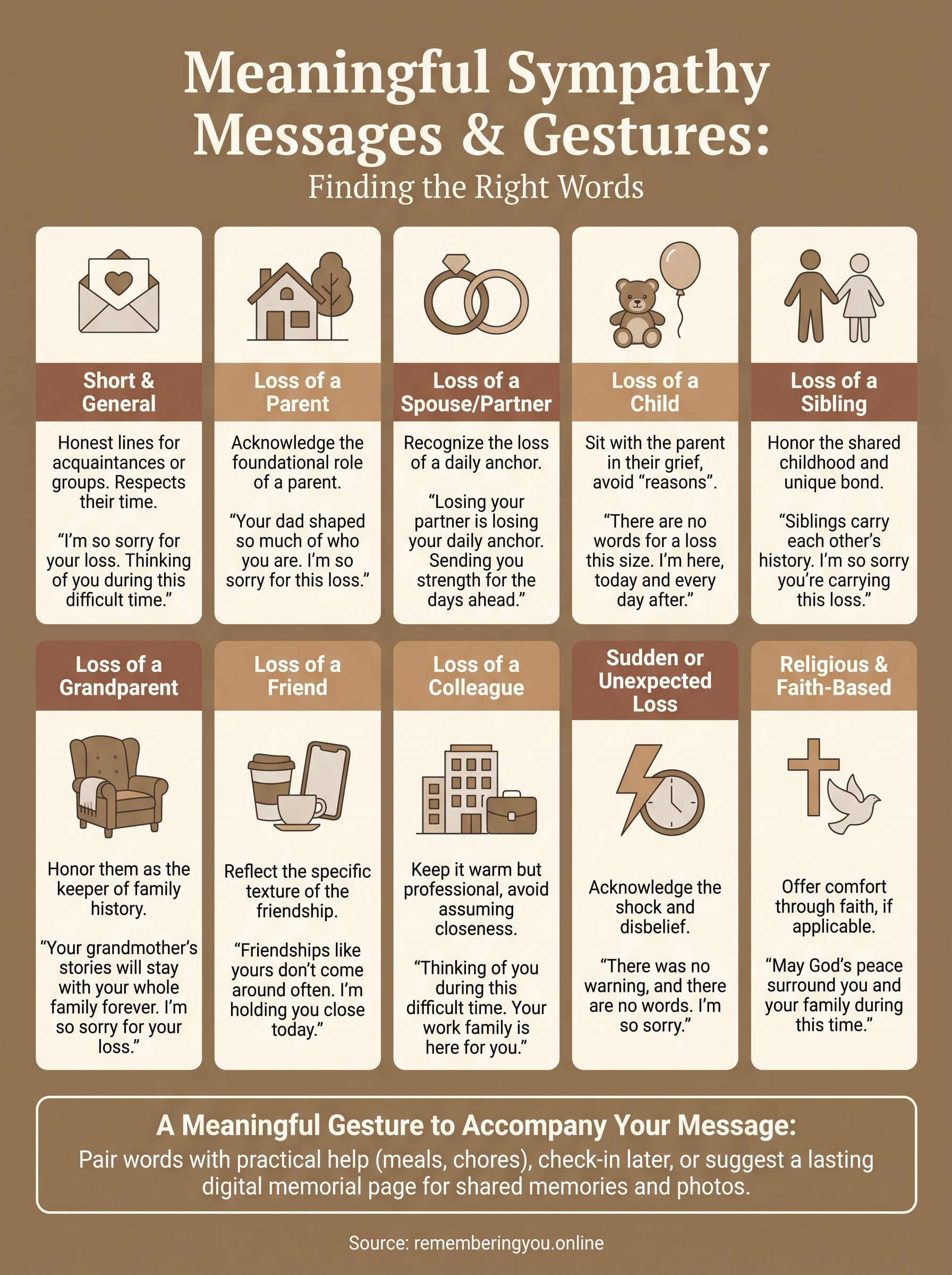
Finding the words that matter most
No single sentence undoes a loss, but the right one tells someone they're not grieving alone. Whether you borrowed a line word for word or adapted it to fit your own relationship with the person who died, what matters is that you showed up with sympathy messages instead of silence. Grieving families remember who reached out, even if they don't remember every word you wrote.
Once the cards stop arriving and the visitors go home, grief keeps going, and that's where a lasting tribute helps. Your handwritten note captures one moment, but a digital memorial page gives family and friends a place to keep adding memories for years. If you're helping someone honor a person or pet they've lost, create a lasting digital tribute page on Remembering You and give your sympathy card a second life, one that outlasts the flowers and the funeral both.