
Obituary Online: What It Is and How to Search for One
Searching for an obituary online usually starts the same way: a name, a city, maybe a date, and a Google search that returns a dozen unrelated results. If you're trying to find a death notice for someone in Wichita, KS, or anywhere else, that scattershot approach wastes time you probably don't have, especially if you're pulling together information for a funeral, a family history project, or just trying to confirm what happened to someone you lost touch with.
This guide gets straight to the point. You'll learn exactly what an online obituary is, where these notices actually get published, and the specific search strategies that narrow results fast, including Wichita-specific databases and newspaper archives worth checking first.
We'll also cover what to do once you've found the information you need, like how families are increasingly pairing traditional obituaries with a digital memorial page that holds more than a newspaper notice ever could: photos, life stories, and a place where relatives scattered across the country can leave their own memories. If you're here to search, we'll get you there quickly. If you're here to build something lasting, we'll show you that too.
Why online obituaries matter today
Newspapers used to be the only place to find a death notice, and you had to know which paper someone's family used, then dig through microfilm or a paid archive to see it. That model broke down years ago. Today, most funeral homes post obituaries directly to their websites, and services like Legacy.com aggregate notices from thousands of papers nationwide. This shift means an obituary search online now takes minutes instead of a trip to the library, and it works whether you're looking for someone who passed last week or decades ago.
Why families and researchers depend on digital records
Families scattered across states or countries can't gather around a single printed page, so the online version becomes the shared reference point everyone uses to confirm service times, read the life story, and find the funeral home's contact information. Genealogists searching for death notices tied to ancestors rely on the same digitized archives, often cross-referencing them with census records or cemetery listings. Funeral directors know this too, which is why nearly every home now publishes obituaries online by default rather than treating it as an afterthought.
An online obituary isn't just a notice anymore, it's often the only record a family has time to create during the hardest week of their lives.
The gap a printed notice leaves behind
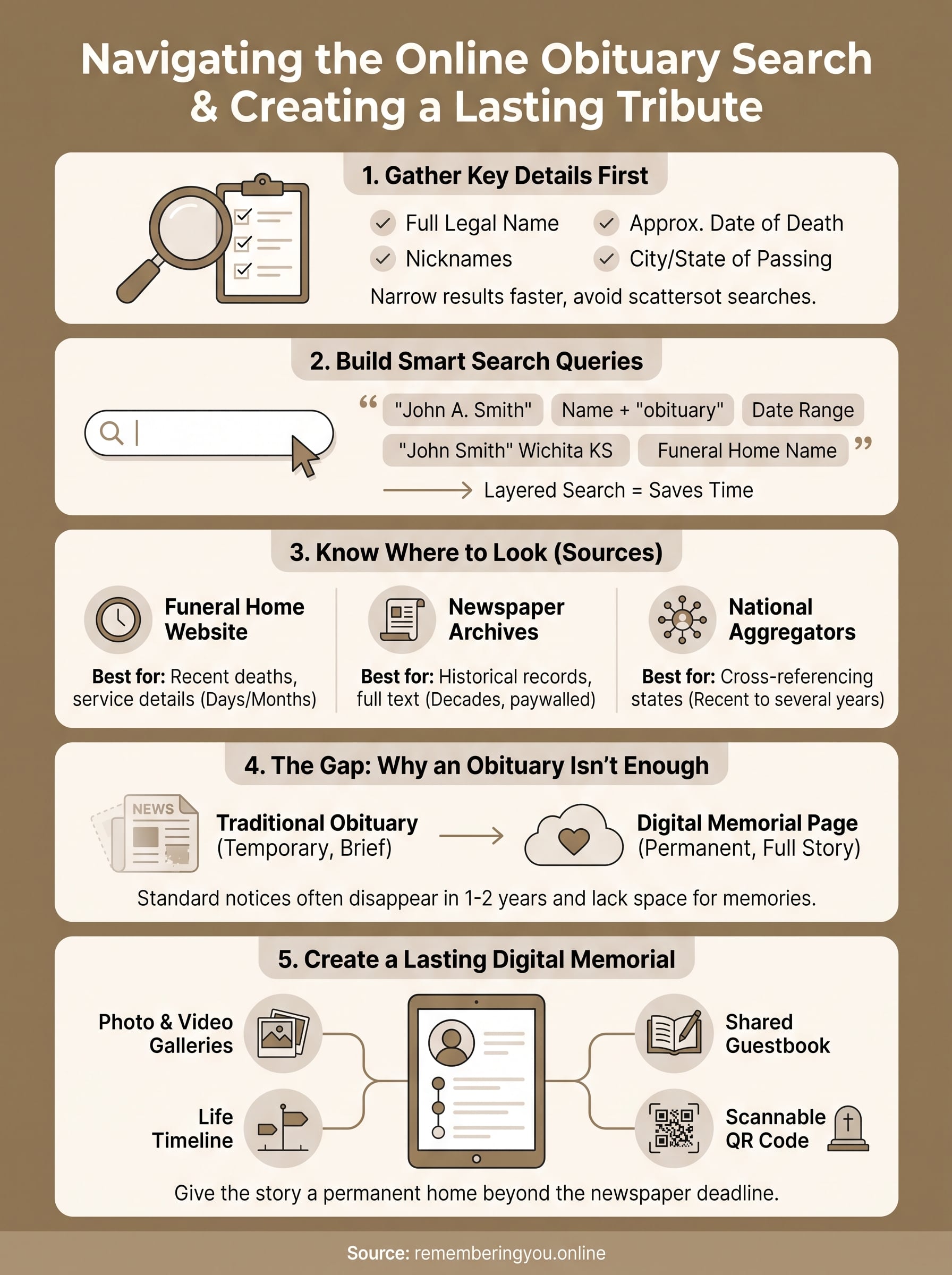
Here's the catch: a standard obituary, whether in print or posted on a funeral home's site, usually disappears from easy view within a year or two, and it rarely holds more than a few paragraphs and one photo. That's a thin record for a full life. It answers who, when, and where, but it doesn't give relatives a place to add memories, upload old photos, or revisit the page five years later. That gap is exactly why more families now pair the obituary with a permanent memorial page, something we'll get into after covering how to actually find the notice you're searching for.
How to search for an obituary online
Start with the basics before you touch a search engine. Gather the full legal name, any nicknames, the approximate date of death, and the city or county where the person lived or passed. These four details narrow results faster than anything else, especially for common names where a bare Google search buries the right obituary under hundreds of unrelated hits.
Build a search that actually works
Once you have those details, structure your query instead of typing a vague phrase. A targeted search saves real time:
- Use quotation marks around the full name: "John A. Smith"
- Add the city or state: "John A. Smith" Wichita KS
- Include "obituary" or "death notice" as a keyword
- Try a date range if you know the approximate year
- Search the funeral home's name if you know which one handled arrangements
This kind of layered search works whether you're checking Google directly or searching within a dedicated obituary database.
The right four details, name, date, city, and funeral home, will find an obituary faster than any generic search ever will.
Know where automated search falls short
Google indexes plenty of obituaries, but paywalled newspaper archives and smaller funeral home sites often don't show up in standard results. That's why a dedicated obituary search through aggregator sites or local newspaper archives usually finds notices that a general web search misses entirely, particularly for older records or smaller towns where digital indexing lags behind larger metro papers.
Where to find obituaries by name, city, or newspaper
Different sources specialize in different kinds of records, so knowing where to look saves you from repeating the same search five times. Local newspaper archives still hold the most detailed obituaries for older records, while national aggregators pull recent notices from thousands of funeral homes at once.

National and regional obituary databases
Start broad, then narrow by location. A funeral home website is often the fastest route for a recent death, since most homes post the full obituary the same day arrangements are finalized. For Wichita specifically, check The Wichita Eagle's obituary section and local funeral home sites like those serving Sedgwick County, since smaller regional papers rarely get picked up by national aggregators.
| Source type | Best for | Typical coverage window |
|---|---|---|
| Funeral home website | Recent deaths, service details | Days to a few months |
| Newspaper archive | Historical records, full text | Decades, often paywalled |
| National aggregator | Cross-referencing multiple states | Recent to several years |
If you're searching for a Wichita death notice, start with the local paper and funeral home site before trying a national database.
When the trail runs cold
Sometimes none of these turn up a match, especially for deaths that predate widespread digital archiving. County clerk offices and public library genealogy desks often hold microfilm records that never made it online, and Wichita's public library maintains local obituary indexes going back further than most digital databases reach.
How to create a lasting tribute beyond the obituary
Once you've found or written the obituary, the next question is what happens to that record after the funeral home takes the page down. A digital memorial page solves that problem by giving the family a permanent home for the story, separate from any newspaper deadline or hosting fee tied to a funeral home's site.
What a lasting tribute adds that an obituary can't
An obituary answers who, when, and where. A memorial page answers everything else: childhood stories, the nickname only cousins used, wedding photos, a video from a birthday years back. Free memorial pages built for this purpose typically include a life timeline, a guestbook where relatives leave memories, and privacy settings so the family controls who sees it.
A newspaper notice tells people someone died. A memorial page tells people who that person actually was.
Practical features that make a page worth building
Look for these when choosing where to build the tribute:

- Photo and video galleries, not just a single portrait
- A shared guestbook for condolences and memories
- A life timeline for milestones in order
- Password protection for family-only pages
- A scannable QR code that links a headstone or memorial card directly to the online page
That last feature matters more than people expect. Relatives visiting a gravesite years later can scan the code and land straight on the full story, no search required.
Keeping a life story alive
Finding an obituary online answers the immediate question: who, when, and where. But once you've searched, confirmed the details, and maybe printed a copy for the service, you're left with the same gap every family faces. A few paragraphs and one photo can't hold a whole life. That's the real reason digital memorial pages have become the natural next step after the obituary search ends, they give the story somewhere permanent to live, away from paywalls and deadlines.
If you've just found the notice you were looking for, or you're planning ahead for someone you love, don't stop at the search. Build the fuller record now, while photos and memories are still easy to gather. Create a free memorial page and give that life story a home that outlasts any newspaper archive.