
Eulogy Examples: How to Write a Heartfelt Tribute
You've got a few days, maybe less, to write something you've never written before, and it has to be right. Staring at a blank page while grieving is brutal, which is why searching for examples eulogy is often the first practical step people take once the shock wears off. You're not trying to plagiarize someone else's words. You're trying to see how other people turned love and loss into something they could actually say out loud without falling apart.
This guide gives you real eulogy examples for a parent, spouse, sibling, friend, or pet, along with funeral eulogy examples and celebration of life formats you can adapt instead of copy. You'll see what makes a tribute land emotionally versus what makes it drag, and how structure actually helps you get through the reading, not just the writing.
Below, you'll find a breakdown of eulogy structure, several full sample speeches for different relationships, and tips on pacing, tone, and length so you're not guessing at the podium. If you're also building a lasting online tribute alongside the service, a free memorial page with photos, a timeline, and a guestbook on Remembering You pairs well with the words you write here.
What is a eulogy and how long should it be
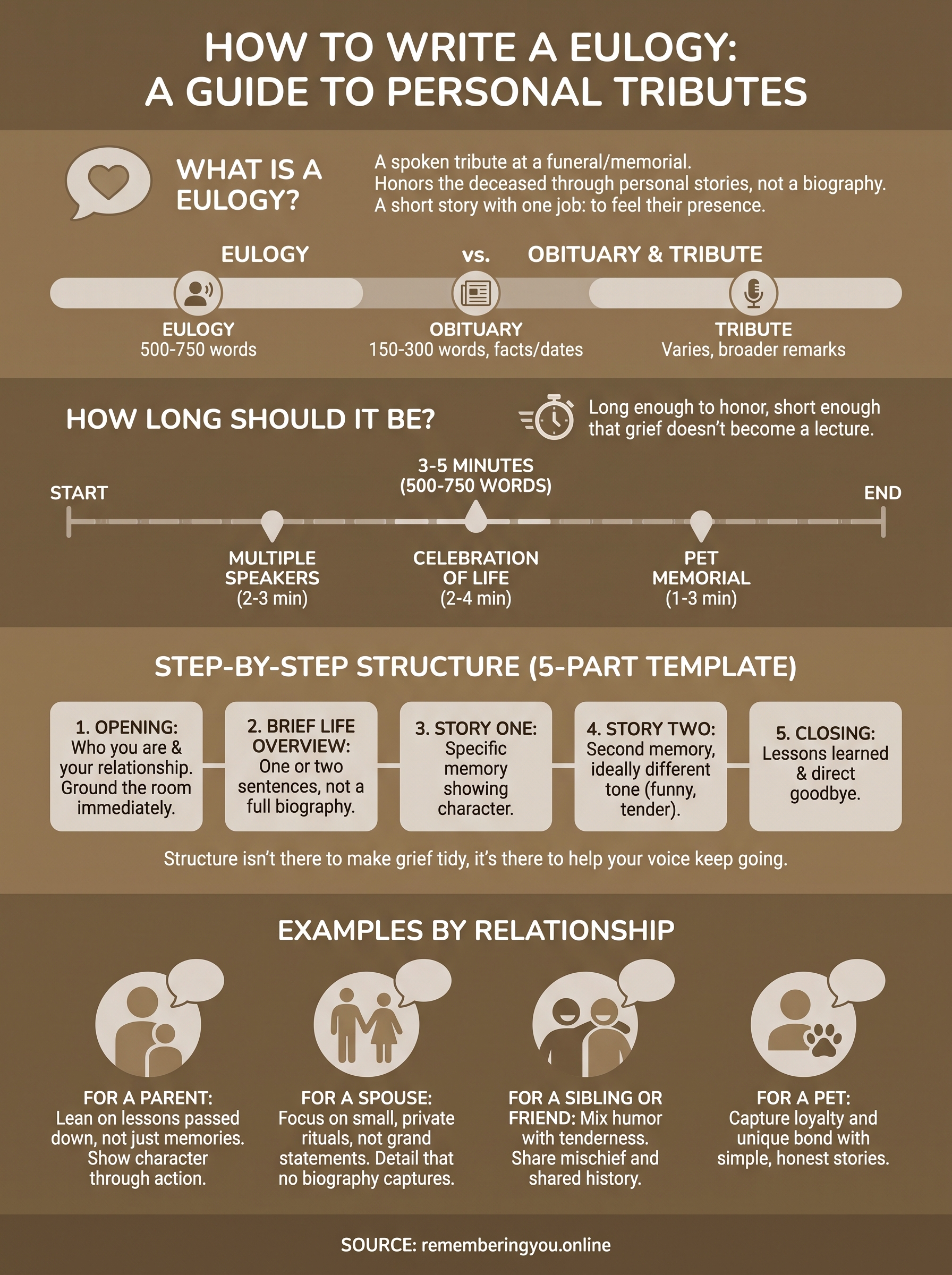
A eulogy is a spoken tribute delivered at a funeral, memorial service, or celebration of life, meant to honor the person who died and help the room remember who they really were. It's not a biography and it's not an obituary. Think of it as a short story with one job: to make people feel the presence of someone who's gone, using specific memories instead of general praise. Examples of a eulogy almost always share this trait, they trade broad statements like "she was a wonderful mother" for a moment that shows it, like the time she drove three hours in a snowstorm because you forgot your retainer.
How long a eulogy should be
Length matters more than most first-time writers expect. Grief makes time feel strange, both for you at the podium and for the people listening, so a eulogy that runs too long loses its emotional weight fast. Most funeral eulogies land between 3 and 5 minutes, which works out to roughly 500 to 750 words when read at a natural, unhurried pace.
A eulogy should be long enough to honor a life, and short enough that grief doesn't have to sit through a lecture.
Use this as your planning guide:
- Single speaker, standard service: 3 to 5 minutes (500-750 words)
- Multiple family members speaking: 2 to 3 minutes each (350-450 words)
- Celebration of life with open floor: 2 to 4 minutes (300-600 words)
- Pet memorial tribute: 1 to 3 minutes (150-450 words)
Read your draft aloud with a timer before the day of the service. Grief slows people down, so whatever time your draft takes in a calm living room, add another 20 to 30 seconds for the actual delivery.
Eulogy vs. other tribute formats
One mix-up trips up a lot of first-time writers: confusing a eulogy with the obituary itself, which follows its own format or a general tribute speech. They overlap, but they serve different audiences and different moments.
| Format | Purpose | Typical Length | When It's Used |
|---|---|---|---|
| Eulogy | Personal, spoken tribute with stories | 500-750 words | Funeral or memorial service |
| Obituary | Factual life summary, dates, survivors | 150-300 words | Newspaper, funeral program, online |
| Tribute speech | Broader remarks, can include humor or advocacy | Varies | Celebration of life, anniversary of passing |
| Eulogy for a pet | Personal, informal remembrance | 150-450 words | Pet memorial or private gathering |
Seeing the differences laid out makes it easier to figure out which one you're actually being asked to write, whether that's a eulogy, an obituary, or a broader tribute speech that honors a life well lived. If a funeral director or family member says "eulogy," they want your personal memories, not a recitation of the deceased's résumé. That distinction shapes everything you do next, from which stories you pick to how you open the speech.
Step 1. Gather memories and choose your key stories
Before you write a single sentence, spend time collecting raw material. Open a blank document or grab a notebook and just dump memories without editing yourself. Write down the small stuff: the phrase they always said, the way they laughed at their own jokes, the ritual you shared every Sunday. Most eulogy examples for family member speeches work because they're built from three or four specific, sensory moments rather than a list of accomplishments.
Ask other people what they remember
Don't rely only on your own memory bank. Text or call three to five people who knew the person differently than you did, a coworker, a childhood friend, a sibling. Ask one simple question: "What's a moment with them that you'll never forget?" You'll often get the story that becomes your best material, because outside perspectives reveal sides of a person you never saw firsthand.
The best eulogies aren't written from memory, they're assembled from everyone's memories.
Narrow down to two or three stories
Once you've got a page full of memories, pick the two or three that best capture who this person actually was, not who they were supposed to be. A good filter:
- Does this story make you feel something when you retell it?
- Would someone who never met them understand the person better after hearing it?
- Does it reflect a value they lived by, not just an event that happened to them?
Skip anything that requires inside knowledge to land, and cut stories that only work as jokes among family. A celebration of life eulogy examples search often turns up speeches that mix one funny memory with one tender one, and that balance is worth copying even if the words aren't, especially if the family is planning a celebration of life that breaks the mould. Once you've settled on your stories, you're ready to build them into something deliverable, which is where structure comes in.
Step 2. Structure your eulogy with a simple template
Once you've picked your stories, structure keeps you from rambling or freezing mid-sentence. A simple five-part frame works for almost every funeral eulogy example you'll find, whether the person spoke for two minutes or eight, and our complete guide to writing a meaningful eulogy walks through each part in detail. You don't need to be a writer to follow it, you just need to fill in the blanks with the memories you already gathered in step one.

The five-part eulogy template
Here's the skeleton to build from:
1. Opening: Who you are and your relationship to the deceased
2. Brief life overview: One or two sentences, not a full biography
3. Story one: A specific memory that shows their character
4. Story two: A second memory, ideally a different tone (funny, tender, quiet)
5. Closing: What they taught you, and a direct goodbye
Each section can run just a few sentences. Good eulogy examples rarely spend more than a paragraph on biography, because the room already knows the basic facts from the program or the obituary. They want the parts only you can tell them.
Structure isn't there to make grief tidy, it's there to help your voice keep going when your heart wants to stop.
Opening and closing lines that work
Your first and last lines carry the most weight, since they're what people remember walking out the door. Skip generic openers like "I'm not sure I can do this" and instead ground the room immediately: "My dad taught me to fish, argue about politics, and never leave a diner without tipping 20 percent." That single line does the job of an entire introduction.
Closing lines work the same way. Instead of trailing off, address the person directly: "Mom, thank you for teaching me how to be brave. I'll try to make you proud." Direct address at the end turns a speech into a farewell, which is exactly what the room came to witness.
Step 3. Write, practice, and deliver with confidence
Writing the actual draft goes faster once you have your stories and template locked in. Write it like you talk, not like an essay, because a eulogy is meant to be heard, not read silently. Use short sentences and simple words. Avoid long clauses that force you to hold your breath mid-sentence, since you'll need those pauses for composure, not grammar. Read every paragraph out loud as you write it. If a line trips your tongue on the third read, it'll trip you worse at the podium.
Practice out loud, multiple times
Rehearsal matters more for a eulogy than almost any other kind of speech, because grief affects your breathing and pacing in ways you can't predict from the page. Practice your draft out loud at least five times before the service, ideally in front of one trusted person who can tell you where it drags or where a line lands oddly. Time yourself each run. If you're consistently near the top of your allotted range, trim a sentence rather than rushing the delivery later.
Practice doesn't remove the emotion from a eulogy, it just makes sure the emotion doesn't stop you from finishing.
Delivery tips for the day
On the day itself, a few small habits make a real difference:
- Print your speech in large font and number the pages, in case your hands shake or a page slips.
- Bring water and take a sip if you need a pause, nobody will mind.
- Look up periodically, even briefly, rather than reading every word to the page.
- Give yourself permission to pause if you tear up. Silence reads as sincerity, not failure.
- Ask someone to stand nearby who can step in and finish reading if you can't continue.
Delivering eulogy speech examples well isn't about performing flawlessly. It's about staying present enough that the room feels the love in the words, even if your voice cracks halfway through.
Eulogy examples for every relationship and occasion
Every relationship carries its own emotional shorthand, so the best eulogy examples rarely sound alike. A tribute to a father hits different notes than one for a spouse or a childhood best friend, and adapting a template means paying attention to those differences rather than forcing the same phrasing onto every loss.
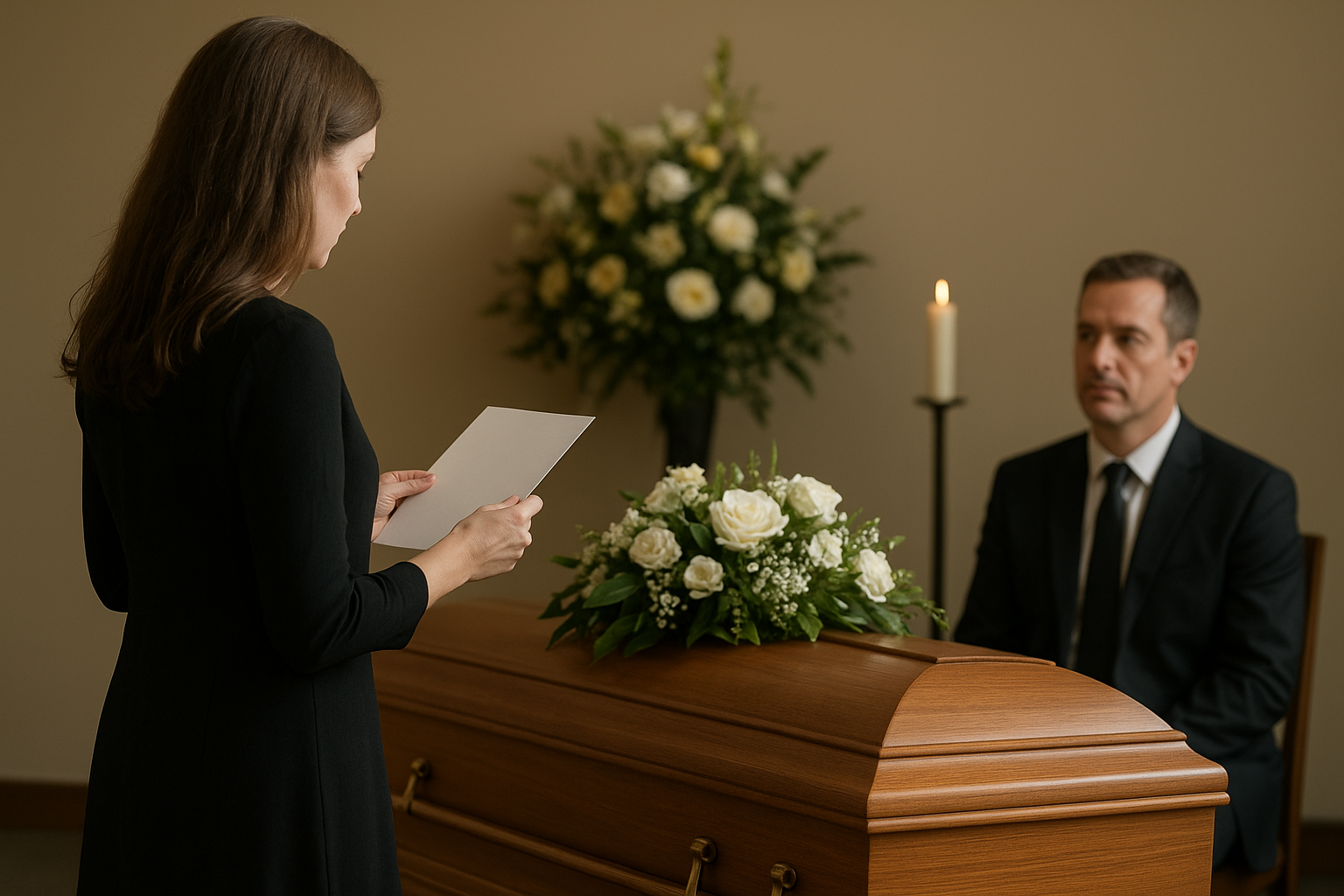
Eulogy examples for a parent
Speeches for a mother or father often lean on lessons passed down, not just memories shared, and these sample eulogy speeches for a father show how that plays out line by line. A strong opening might sound like: "My mom never once told me she loved me without also telling me to call my sister." That single line does double duty, it's specific and it reveals character through action, which is what separates memorable openings from generic ones.
Eulogy examples for a spouse
A touching eulogy for friend examples search often overlaps with spouse tributes, since both rely on small, private rituals rather than grand statements. Try something like: "He made coffee wrong every single morning for thirty-one years, and I never once told him, because I loved that it was ours." That's the kind of detail no biography could capture.
The right example doesn't hand you words, it hands you permission to trust your own small, ordinary memories.
Eulogy examples for a sibling or friend
These tributes tend to carry more humor, since siblings and lifelong friends usually shared mischief along with love. A great eulogy examples structure here often opens with a shared joke before moving into something tender, which keeps the room from feeling weighed down for the entire speech, as these heartfelt eulogies written for a friend show.
Eulogy examples for a pet
Pet memorials can be shorter and more informal, but they deserve the same care. Something like "She waited by the door every day at 5:15, rain or shine, for eleven years" captures loyalty without overreaching. If you're building a lasting tribute alongside the words, Remembering You's pet memorial pages let you pair the speech with photos and a shareable page, and there are plenty of other ways to honor a dog you've lost.
Finding the words to say goodbye
Writing a eulogy never gets easy, but it does get clearer once you have a structure and a few honest stories to lean on. You don't need perfect prose or a dramatic finish. You need three real memories, a simple five-part frame, and the courage to read them out loud, even if your voice shakes. That's what separates a tribute people remember from one they politely forget, and it's why examples eulogy searches exist in the first place, not for scripts to copy, but for proof that ordinary words can hold extraordinary love.
Once the service ends, the words don't have to disappear with it. If you want family scattered across states or countries to revisit the stories you told, build a free memorial tribute page and give your eulogy a permanent home alongside photos, a timeline, and a place for others to add their own memories.