
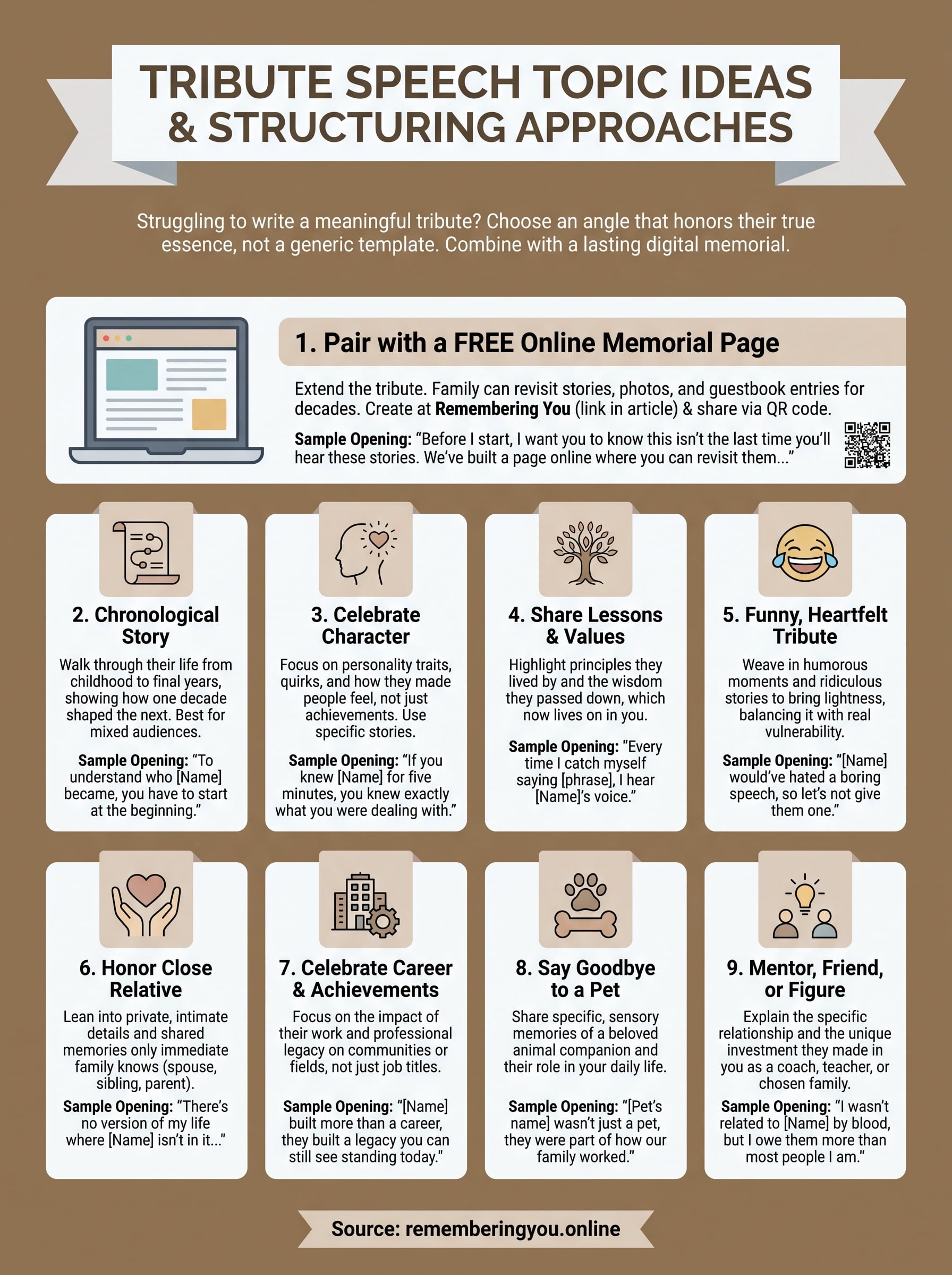
9 Tribute Speech Ideas That Honor a Life Well Lived
Staring at a blank page the night before a funeral or memorial service is one of the worst kinds of pressure. You want to get it right, say something that actually captures the person, and not just recite a list of dates and accomplishments. If you're searching for tribute speeches ideas, you're probably running out of time and patience with generic templates that could describe anyone.
This list gives you real tribute speech topic ideas you can adapt right away, whether you're speaking for a parent, a spouse, a close friend, or even a beloved pet. Each idea focuses on a different angle: humor, legacy, small everyday moments, or the values someone lived by, so you can pick whichever fits the person and the room.
Below you'll find nine approaches for structuring a tribute speech, along with specific prompts to help you fill in the details that make it personal. And once you've written something you're proud of, consider pairing it with a lasting online memorial page, where family and friends scattered across the country can revisit those same stories anytime they want.
1. Pair your speech with a free online memorial page
A tribute speech lasts a few minutes. The people who loved that person will want to revisit the stories, photos, and memories for years, not just on the day of the service. That's where a digital memorial page comes in. You can create a beautiful online memorial page for free at Remembering You, then read directly from it during your speech or share the link (or a printed QR code) with guests afterward so the tribute doesn't end when you sit down.
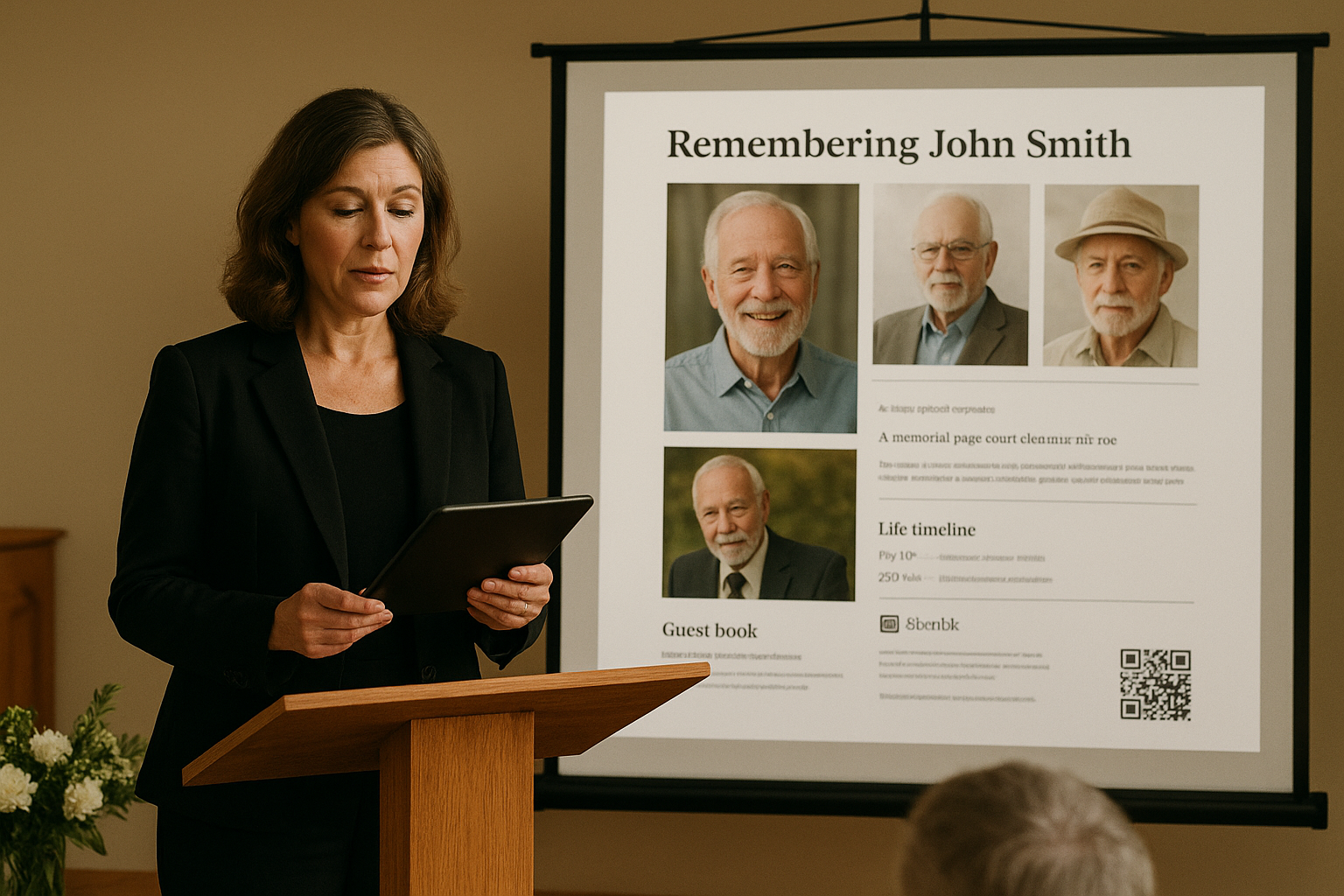
A eulogy fades from memory within days. A memorial page keeps the stories alive for decades.
Who it's for
This idea works best for anyone planning a memorial service, funeral, or celebration of life where family members live far apart. If cousins couldn't fly in, or an old army buddy couldn't make the drive, a shareable page lets them add their own memories to the same guestbook you're reading from at the podium.
What to include
Build the page before you write the speech. It'll actually help you organize your thoughts. Add:
- A handful of photos spanning different decades of their life, arranged with a few creative photo tribute ideas
- A short biography you can lift lines from for your opening or closing
- A life timeline marking milestones like weddings, career changes, or big moves
- An online memorial guestbook where attendees can leave condolences after the service
- A QR code, printed on the program or a memorial card, so guests can scan and visit instantly
These same details double as the raw material for your speech. Once you've written the biography section, you already have a rough draft of your opening paragraph.
Sample opening line
"Before I start, I want you to know this isn't the last time you'll hear these stories. We've built a page online where you can revisit them, add your own, and share them with anyone who couldn't be here today." Closing your speech by pointing guests to the QR code on the program gives them a way to keep grieving together long after the reception ends, and it turns a one-time speech into an ongoing tribute the whole family can keep adding to.
2. Tell the story of their life from beginning to end
A chronological tribute speech walks the room through a life in order, from childhood to their final years. It's the most traditional structure, and there's a reason it still works: it gives listeners a full arc, not just scattered highlights. This approach suits a speech where the audience includes people who only knew one chapter of the person's life, like coworkers who never met their childhood friends, or grandchildren who never saw their wilder younger years.
The best chronological tributes don't just list years, they show how one decade shaped the next, which is exactly what life timeline memorials are built to do.
Who it's for
This works well for funerals with a mixed audience, spanning generations and different circles who each hold a different piece of the story.
What to include
Pick three or four turning points instead of trying to cover everything:
- Where and when they were born, and one detail about their childhood
- A defining choice in early adulthood, like a career path or a move
- The family they built or the community they became part of
- How they spent their later years, and what still lit them up
Sample opening line
"To understand who [Name] became, you have to start at the beginning." From there, walk forward year by year, letting each stage explain the next, so the ending feels earned rather than sudden.
3. Celebrate the character that made them unforgettable
Some people aren't remembered for what they achieved, but for how it felt to be around them. A character-driven tribute skips the résumé entirely and zeroes in on personality: the stubbornness, the wit, the way they hugged too tight or laughed too loud. This approach works when the person's presence, not their accomplishments, is what everyone in the room actually wants to talk about at the reception anyway.
People forget what someone did for a living long before they forget how that person made them feel.
Who it's for
Choose this angle for someone whose personality traits were the whole point, the aunt who never missed a birthday call, the friend who could talk to anyone in a room full of strangers.
What to include
Build the speech around specific traits, not vague praise:
- One word that instantly makes people nod (stubborn, generous, mischievous)
- A short story that proves that trait, ideally one most guests haven't heard
- A quirk or habit that made them recognizable, like a catchphrase or a signature dish
- How that trait showed up even in hard times
Sample opening line
"If you knew [Name] for five minutes, you knew exactly what you were dealing with." Let that line set up the story that follows, so the audience laughs or nods before you even explain why.
4. Share the lessons and values they passed down
Some tributes work best when they shift the focus away from the person and onto what they left behind in you. A values-based tribute speech pulls out the principles someone lived by, the sayings they repeated, the habits they modeled, and shows how those things now live on in the people they raised or mentored. This idea for a tribute speech suits someone who saw teaching moments everywhere, even if they never called it teaching.
The best inheritance isn't money or furniture, it's the phrases you catch yourself repeating to your own kids.
Who it's for
This angle fits a parent, grandparent, or teacher whose influence shows up in how their family still makes decisions, treats strangers, or handles hard days.
What to include
Anchor the speech in specific, repeatable wisdom rather than general character traits:
- A phrase or saying they repeated often, word for word if you can remember it
- A moment when following their advice actually paid off
- A value they modeled through action more than words, like generosity or patience
- How you or someone else has already passed that lesson on
Sample opening line
"Every time I catch myself saying [phrase], I hear [Name]'s voice." Building the rest of the speech around two or three lessons, instead of one long list, keeps the tribute focused and gives the audience something concrete to carry out of the room with them.
5. Bring lightness with a funny, heartfelt tribute
Some funerals need permission to laugh, and a funny tribute speech gives the room exactly that. This doesn't mean turning the service into a comedy set. It means weaving in the moments that made the person ridiculous, unpredictable, or hilarious on purpose, then letting that humor sit right next to the grief instead of replacing it. The goal is a speech people remember for making them laugh through tears, not one that avoids the sadness altogether.
The funniest tributes work because they never pretend the loss isn't real.
Who it's for
This approach suits someone who used humor as their love language, the dad with the terrible puns, the grandmother who swore like a sailor at bingo, or the friend who never let a room stay serious for long.
What to include
Balance the laughs with at least one honest, tender beat so the speech doesn't feel one-note:
- A story that still makes family members laugh when they retell it
- A running joke or bit only the inner circle will fully get
- One moment of real vulnerability that grounds the humor
- A line that brings the room back to why everyone showed up
Sample opening line
"[Name] would've hated a boring speech, so let's not give them one." That single line signals to the room it's okay to smile, which usually earns you an easier laugh a few sentences later when you need it most.
6. Honor a parent, sibling, spouse, or close relative
Family tributes carry a weight that other speeches don't, because the relationship itself is part of the story. When you're writing a eulogy for a parent, sibling, or spouse, the audience already expects intimacy, so you don't need to explain who this person was in general terms. You can go straight to the private details only you had access to, the inside jokes, the arguments, the years of ordinary Tuesdays that added up to something huge.
The closest relationships produce the smallest, truest details, and those are what the room actually wants to hear.
Who it's for
Choose this angle if you're the immediate family member speaking, a child honoring a parent, a spouse standing up after decades together, or a sibling who shared a childhood no one else witnessed.
What to include
Lean into specifics that outsiders wouldn't know:
- A private nickname or ritual only your family used
- A hard season you got through together, and what it taught you both
- A physical detail, like their handwriting, their laugh, or their cooking
- What you'll miss on an ordinary day, not just holidays
Sample opening line
"There's no version of my life where [Name] isn't in it, so forgive me if this speech feels more like a conversation." Speaking directly to them, rather than about them, often makes this kind of tribute speech idea feel less like a performance and more like the goodbye it actually is.
7. Celebrate their career and lasting achievements
Some people spend forty years building something bigger than themselves, a business, a hospital wing, a classroom full of kids who went on to do great things. A career-focused tribute gives that work its due, without turning the speech into a resume reading. The trick is showing why the work mattered, not just what the title was.
Nobody remembers a job title at a funeral, they remember what that person built and who it helped.
Who it's for
This idea suits someone whose professional legacy shaped a community, a company, or an entire field, the founder, the longtime teacher, the doctor who delivered half the town's babies.
What to include
Ground the speech in impact, not just accolades:
- One accomplishment that still shapes people's lives today
- A colleague or mentee's story that shows the ripple effect of their work
- A setback they pushed through, since resilience says more than a title ever could
- How they talked about their work at home, away from the office
Sample opening line
"[Name] built more than a career, they built a legacy you can still see standing today." From there, naming one specific person whose life changed because of that work grounds the tribute in something real instead of a list of job titles and dates.
8. Say goodbye to a beloved pet
Grief for a pet doesn't get taken as seriously as it should, but anyone who's lost a dog, cat, or any animal that shaped their daily life knows the loss is real. A pet tribute speech works at a small backyard gathering, a vet's memorial service, or just a few words shared with family before scattering ashes. You don't need to justify why the loss hurts. You just need to tell the room who this animal actually was.

A pet doesn't need a résumé to deserve a proper goodbye.
Who it's for
This idea fits anyone honoring a companion animal, whether it's a childhood dog you want heartfelt dog tribute ideas for, a rescue cat who took years to trust you, or a pet that helped a family through a hard stretch of life.
What to include
Keep the speech grounded in specific, sensory memories:
- How the pet came into your life, and what that day was like
- A habit or quirk that made them recognizable, like a favorite spot or a bark you'd know anywhere
- A moment they showed up for you emotionally, even if that sounds silly to say out loud
- What the house feels like without them now
A free pet memorial page gives you somewhere to keep their photos and story long after the speech ends.
Sample opening line
"[Pet's name] wasn't just a pet, they were part of how our family worked." Letting yourself get specific about the ordinary routines you'll miss usually says more than any grand statement about loyalty ever could.
9. Pay tribute to a mentor, friend, or public figure
Not every tribute speech honors a blood relative. Sometimes the person who shaped your life most was a coach, a teacher, a boss, or a friend you chose rather than inherited. A mentor tribute speech works differently than a family eulogy because you're often explaining a relationship the audience didn't witness firsthand, so you need to earn their understanding of why this person mattered to you specifically.
The people who chose to invest in you deserve a speech that explains exactly what that investment looked like.
Who it's for
This idea suits someone honoring a mentor, coach, teacher, or close friend, especially when the audience includes people who knew the person in a completely different context, like former students, teammates, or colleagues.
What to include
Focus on the specific relationship rather than a general list of the person's qualities:
- How you first met, and what pulled you toward them
- A specific piece of advice or moment of support that changed your direction
- What set them apart from other mentors or friends you've had
- How you've tried to pass along what they gave you
Sample opening line
"I wasn't related to [Name] by blood, but I owe them more than most people I am." From there, naming one concrete decision you made because of them shows the audience exactly why you earned a place at this podium.
Finding the words that honor them best
None of these nine approaches is the "correct" one. The right tribute speech idea is whichever one matches the person you're honoring and the room you'll be standing in front of. A career-focused tribute falls flat for someone whose real legacy was Sunday dinners, just like a funny speech misses the mark for a service that needs quiet reverence. Trust what you already know about them, and let that guide which angle you pick.
Whatever structure you choose, write it in your own voice, not the voice you think a eulogy is supposed to have. The audience wants to hear from you, not a template. Once you've found the words, give them a permanent home. Create a tribute page that lasts forever, free, and let the stories you shared at the podium keep reaching family and friends long after the service ends.