
10 Grief Support Groups Near You to Find Help Today
Losing someone leaves a specific kind of exhaustion that no one warns you about, and scrolling through generic search results at 2 a.m. looking for grief support groups near me only adds to it. You want a real place, a real time, a real person across from you who gets it, not another list of hotline numbers you'll never call.
This guide gives you actual starting points: national organizations with local chapters, hospital and hospice bereavement programs, faith-based circles, and pet loss groups, all searchable by zip code so you can find grief support meetings near me this week instead of next month. Each entry includes what the group actually does, who it's best suited for, and how to get in the door.
We also cover what to expect at your first meeting and how to tell a good fit from one that isn't, because showing up matters more than picking the
1. Hospice-based grief support groups
Most people don't realize that hospice bereavement programs stay open long after the funeral is over. By law, Medicare-certified hospices must offer bereavement services to the family for at least 13 months following a death, whether or not your loved one was actually a hospice patient in your area. That means the hospice that cared for your mother, your neighbor's father, or even a hospice you've never used before might run a group you can join tomorrow.
What it offers
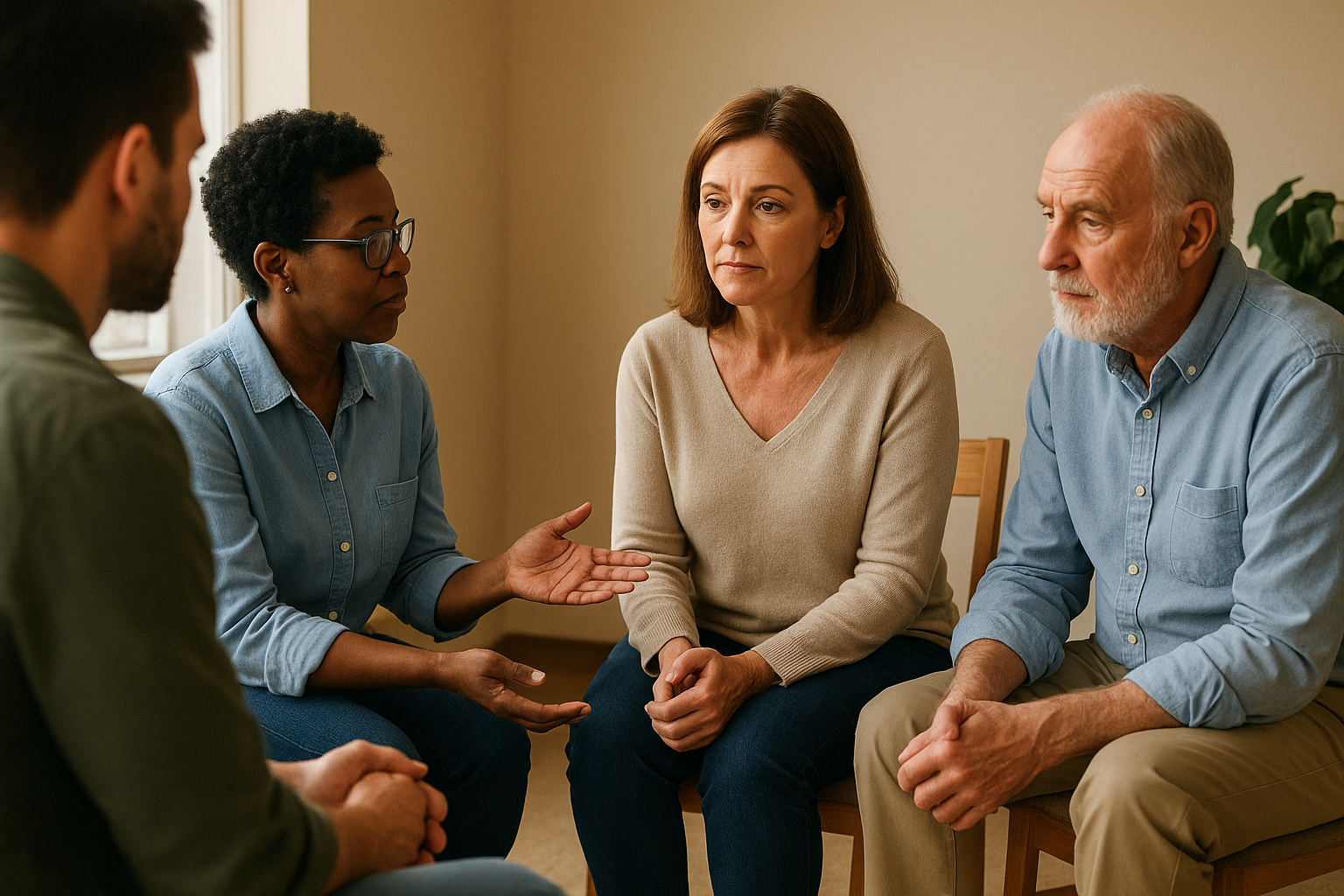
Hospice programs typically run structured, closed groups (six to eight sessions with the same members) alongside open drop-in circles you can attend anytime. Sessions are led by licensed social workers or trained bereavement counselors, not volunteers reading from a script, so the facilitation tends to be more clinically informed than a peer-only meeting. Many hospices also host memory events like candlelight ceremonies or ornament-making nights around the holidays, which double as low-pressure ways to meet other grieving families before committing to a full group.
Who it's for
This option suits people who lost someone to a prolonged illness, cancer, dementia, or old age, especially if hospice was involved in the final months. It also works well if you want a professionally facilitated group rather than a purely peer-led one. Once you've processed the immediate loss, many families use these connections as a bridge to building something lasting, like a shared photo and story archive you can set up as a memorial website at no cost, so extended family who couldn't attend the funeral still feel included.
A hospice bereavement group is often the fastest, most professionally guided grief support meetings near me you can find, and it's usually free.
How to find one near you
Start with the hospice that treated your loved one and ask for the bereavement coordinator directly. If none was involved, search
2. GriefShare faith-based support groups
GriefShare is the largest network of faith-based grief support meetings in the country, running in an estimated 10,000 churches across the United States and several other nations. It's built around a 13-week video curriculum paired with small-group discussion, so unlike a drop-in circle, you're working through a structured program with the same people each week.
What it offers
Each session pairs a video seminar featuring grief experts and other bereaved people with a workbook and a facilitated small-group discussion afterward. Topics move chronologically through the grief process, from the initial shock of loss to rebuilding a life afterward, much like the classic map of denial through acceptance, and the program repeats on a cycle, so you can join at the start of any new 13-week session. Groups also lean on Christian teaching and prayer, though most welcome anyone regardless of denomination or belief.
Who it's for
This format suits people who want spiritual framing alongside emotional support, and who prefer a defined curriculum over open-ended talk. It's a strong fit if you're already connected to a church community, or if you specifically want grief support meetings near me that address faith questions like why God allowed the loss to happen.
A structured, faith-based curriculum works best when you want a clear roadmap through grief rather than an open-ended conversation.
How to find one near you
GriefShare's own website has a zip-code search tool listing local host churches, meeting days, and whether registration is required. Many hospitals and hospice bereavement coordinators also keep a list of nearby GriefShare sessions on hand.
Typical cost
Most host churches charge a small one-time fee, usually $15 to $20, to cover the workbook. Some churches waive it entirely for anyone who can't afford it, so it's worth asking before assuming cost is a barrier.
3. Online and virtual grief support groups
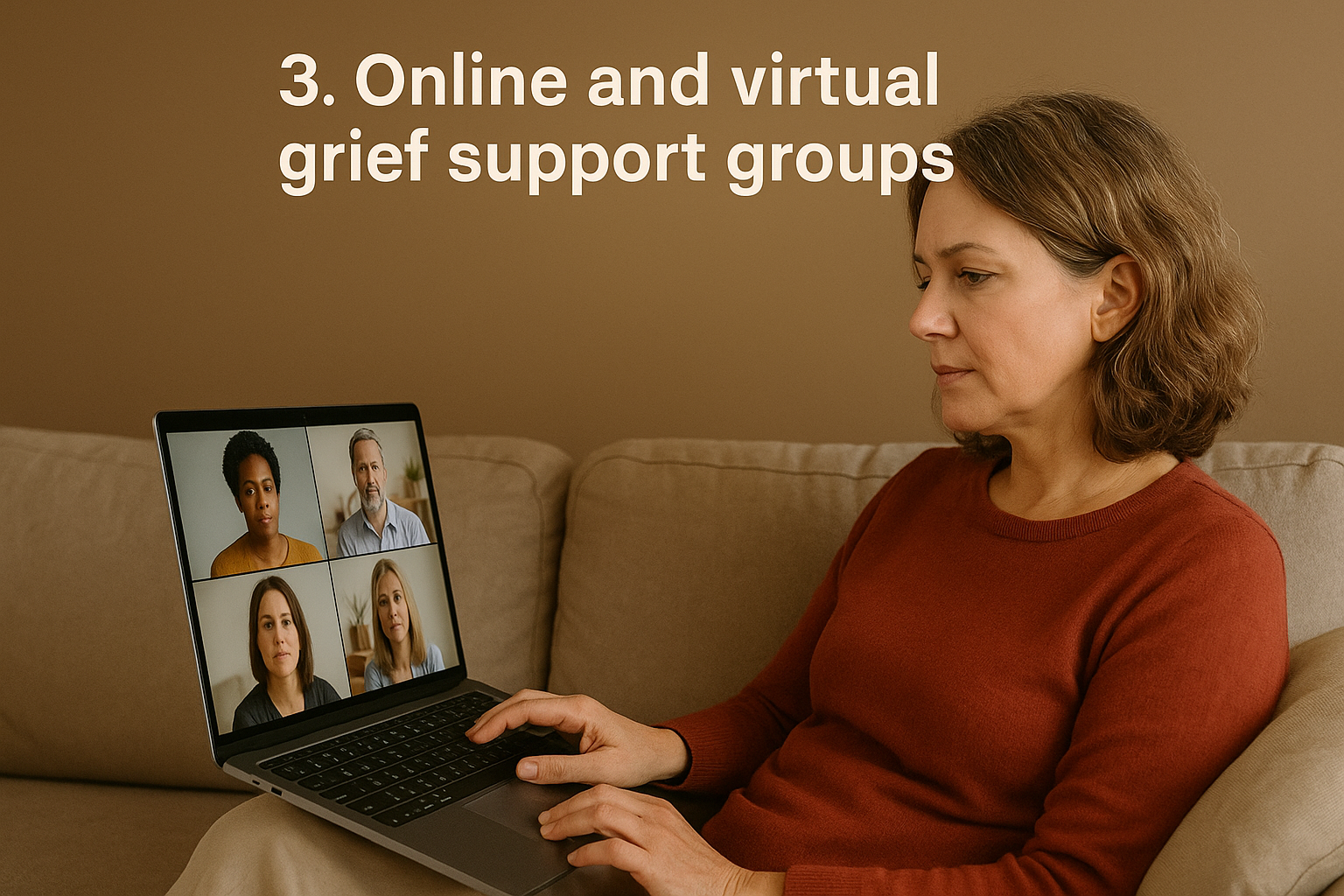
Geography stops mattering the moment you join a virtual grief group. Online grief support exploded during the pandemic and never went back, so now you can find a live video meeting for almost any loss type, on almost any night of the week, without leaving your couch. This matters most for rural areas, night-shift workers, or anyone whose local options are limited to one general bereavement circle a month.
What it offers
Sessions run over Zoom or a similar platform, usually 60 to 90 minutes, led by a licensed counselor or a trained peer facilitator. Formats range from open drop-in chats to closed cohorts that meet weekly for six to twelve weeks. Some platforms also offer asynchronous forums and private messaging boards, so you can process grief at 3 a.m. without waiting for a scheduled meeting.
Who it's for
Caregivers, people in rural areas, and anyone whose loss doesn't fit a neat local category all do well here. It also suits people who feel exposed in a small in-person room and want the option to keep their camera off while they listen. If you're searching grief support groups near me and coming up short because you live somewhere isolated, this is often the fastest real fix.
Distance stops being an excuse the moment you find a virtual grief group that meets on your schedule.
How to find one near you
GriefShare, The Dougy Center, and What's Your Grief all list virtual sessions searchable by loss type rather than location. Facebook groups moderated by hospice organizations are another reliable, if less clinical, option.
Typical cost
Most nonprofit-run virtual groups are free, and there are plenty of other no-cost grief support options you can use from home. Private platforms with licensed therapists running the sessions typically charge $30 to $75 per session, occasionally billed as a monthly membership instead.
4. Local nonprofit grief and loss centers
Every major metro area, and most mid-sized cities, has at least one standalone nonprofit grief center that isn't attached to a hospital or hospice. Places like The Solace Tree, Kara, or your local Bereavement Center run entirely on donations and grants, which means their programming often stretches beyond a single support group into art therapy, camps, and family workshops you won't find anywhere else.
What it offers
These centers usually run multiple concurrent groups organized by relationship to the deceased: spouse loss, parent loss, sibling loss, and adult child loss each get their own room. Beyond weekly meetings, many host seasonal workshops on topics like grieving through the holidays or navigating the first anniversary of a death, where ideas for honoring them on that day often come up. Some also maintain a lending library and a walk-in office where you can talk to staff without an appointment.
Who it's for
Nonprofit centers suit anyone who wants a peer group matched to their specific loss rather than a general bereavement circle. They also work well for people who want an in-person community hub, somewhere they can drop by even outside of scheduled meetings.
A dedicated grief center matches you with people who lost the same kind of person you did, not just anyone who's grieving.
How to find one near you
Search "grief center" plus your city name, or check the National Alliance for Grieving Children and the Association of Death Education and Counseling for regional listings. Local United Way 211 lines also maintain updated referral lists for these centers.
Typical cost
Most nonprofit centers operate on a sliding scale or fully free basis, funded by community donations rather than client fees. A handful ask for a modest suggested donation, often $10 to $20 per session, but no one is turned away for inability to pay.
5. One-on-one grief counseling and therapy
Sometimes a group setting isn't the right fit, and that's not a failure. Individual grief therapy, or what bereavement counseling actually involves, pairs you with a licensed counselor, psychologist, or clinical social worker who works only with you, at your pace, without having to share airtime with six other grieving strangers. It's the option most people default to when a loss is complicated by guilt, anger, or a relationship that wasn't simple before the death.
What it offers
Each session runs 45 to 60 minutes and focuses entirely on your history, your loss, and how it's showing up in your daily life. Therapists trained specifically in grief and bereavement counseling often use approaches like complicated grief therapy or acceptance and commitment therapy, which go beyond general talk therapy. You set the pace and the topics, and sessions can continue for months or years if that's what you need.
Who it's for
This path suits people carrying complicated grief, meaning the loss involves trauma, an estranged relationship, suicide, or symptoms that signal grief needs professional care because they haven't eased after a year or more. It also fits anyone who simply prefers privacy over a shared room, or who's dealing with grief on top of an existing mental health condition that a peer group can't address.
One-on-one therapy exists for the grief that doesn't fit neatly into a group discussion.
How to find one near you
Use Psychology Today's therapist directory and filter by "grief" under specialties, or ask your primary care doctor for a referral. Employee assistance programs (EAPs) through work often cover several free sessions before you need insurance at all.
Typical cost
Without insurance, expect $100 to $200 per session. With insurance, copays typically run $20 to $50, and many therapists offer sliding-scale rates for people paying out of pocket.
6. Support groups for sudden or traumatic loss
Some deaths don't come with warning, and that changes everything about how you grieve. Sudden loss support groups are built specifically for survivors of homicide, suicide, overdose, car accidents, or unexpected medical events, where shock and trauma symptoms sit right alongside grief. These groups exist because standard bereavement circles, built around anticipated loss, often can't hold what a sudden death survivor is carrying.
What it offers
Groups like those run by The Compassionate Friends (for parents), Alliance of Hope (for suicide loss survivors), or Homicide Survivors chapters combine peer support with trauma-informed facilitation. Sessions often address intrusive thoughts, guilt, and hypervigilance alongside standard grief topics, since sudden loss frequently overlaps with post-traumatic stress. Many groups also connect members to victim advocacy resources if the death involved a criminal case or ongoing investigation.
Who it's for
This category fits anyone whose loved one died without warning, especially through violence, accident, or overdose. It's also the right call if a general grief group left you feeling like nobody understood the specific weight of a death that made headlines or triggered a police investigation.
Sudden loss carries a trauma layer that a general grief support group usually isn't equipped to address.
How to find one near you
Alliance of Hope maintains a directory of suicide loss groups by state, and The Compassionate Friends lists chapters for parents who lost a child unexpectedly. Local victim services offices, often connected to your county prosecutor's office, can also refer you if the death involved a crime.
Typical cost
Nearly all sudden loss groups run through nonprofits and victim advocacy programs, so they're free to attend. Occasionally a private trauma therapist specializing in sudden loss will charge standard counseling rates, typically $100 to $200 per session without insurance.
7. Cancer and illness-related bereavement support
Watching someone go through cancer, ALS, or another long illness changes how you grieve once they're gone, because you were already mourning pieces of them for months or years before the death itself. Illness-related bereavement groups exist specifically for that layered grief, the kind that includes relief, exhaustion, and guilt tangled together with plain sadness.
What it offers
Organizations like the American Cancer Society, the ALS Association, and local hospital oncology departments run groups built around the specific arc of a long illness. Sessions cover caregiver burnout recovery, the guilt of feeling relieved when suffering ends, and the strange task of rebuilding an identity after months spent as a full-time caregiver. Some hospitals fold these groups into survivorship centers that also serve family members of patients who are still living, so you may sit next to someone whose spouse is still in treatment.
Who it's for
This fits anyone who spent months or years as a primary caregiver before the death, especially if that caregiving role left little time to grieve in real time. It also suits people wrestling with the specific guilt of relief, a feeling many general grief groups gloss over.
Caregiver grief starts before the death, and a group built for illness-related loss is the only kind that treats it that way.
How to find one near you
Call the social work office at the hospital or cancer center where your loved one was treated, since most keep an active referral list even for families who used other facilities. The American Cancer Society's 24-hour helpline can also connect you to a nearby group the same day you call.
Typical cost
Hospital-affiliated and nonprofit-run groups in this category are almost always free, funded through the same grants that cover patient services. A private grief counselor specializing in caregiver loss typically charges standard therapy rates if you want individual support instead.
8. Children's and teen grief support programs
Kids grieve differently than adults, and a program built just for them makes a real difference when the loss hits a young family. Children's grief support programs use play, art, and peer conversation instead of open-ended talk therapy, because most kids under 12 can't process loss by sitting in a circle and discussing feelings for an hour. Programs like The Dougy Center pioneered this model decades ago, and now similar centers exist in most metro areas under different names.

What it offers
Sessions typically split kids by age group, sometimes as young as three, and pair structured activities like drawing or storytelling with facilitated peer discussion led by trained counselors. Teens often get their own separate group, since a 15-year-old processing a parent's death has little in common with a six-year-old asking where grandma went. Many programs run parallel parent groups in the same building, so caregivers get support while their kids are in session down the hall.
Who it's for
This option fits any family with a child or teenager grieving a parent, sibling, grandparent, or close friend. It also helps parents who feel unequipped to answer a child's questions about death at every age, since facilitators are trained specifically in age-appropriate grief education.
Kids process loss through play and peer connection, not adult-style talk therapy, so match the format to the age.
How to find one near you
The National Alliance for Grieving Children keeps a searchable directory, making it one of the fastest ways to find grief support groups near me built specifically for young people. School counselors and pediatricians often keep local referral lists too.
Typical cost
Most children's grief centers operate free or on a sliding scale, since they're funded by donations and grants rather than family fees.
9. Church and faith community grief ministries
Many congregations run their own grief ministries, separate from GriefShare's licensed curriculum, built instead around the pastor's own approach and the specific needs of the church family. These groups tend to be smaller, less formal, and rooted in an existing community rather than strangers meeting for the first time. If you already attend a church, synagogue, or mosque, this is often the most immediate option available, sometimes starting the same week you ask.
What it offers
Sessions typically blend scripture study, prayer, and open sharing, often built around Bible verses that bring comfort in grief, and are led by a pastor, deacon, or trained lay minister rather than a licensed counselor. Formats vary widely: some meet weekly for a set number of weeks, others run as an ongoing open circle you can join anytime grief resurfaces. Many ministries also pair members one-on-one with a fellow congregant who experienced a similar loss, creating a mentor-style relationship alongside the group meetings.
Who it's for
This suits members of an existing faith community who want grief support wrapped in familiar language and ritual, rather than clinical terminology. It also fits people who find comfort in communal prayer or a shared belief system more than in evidence-based counseling techniques.
A faith community grief ministry works because the people in the room already know you, not just your loss.
How to find one near you
Start by calling your own church office, since most pastors know immediately whether a grief ministry exists or can point you to a sister congregation that runs one. Diocesan and denominational websites often list bereavement ministries by region for grief support meetings near me searches that come up empty elsewhere.
Typical cost
These ministries are almost always free, run by volunteers and funded through the congregation's general budget rather than participant fees.
10. National directories and helplines for local support
When you've tried the categories above and still can't find the right fit, a national grief directory can point you toward options you'd never find through a plain search engine, and city-level roundups like this list of grief support groups in Las Vegas show what those listings look like in practice. These clearinghouses aggregate hospice programs, nonprofit centers, faith-based groups, and virtual meetings into one searchable database, which makes them the fastest way to cover every category in this list at once.
What it offers
Most directories let you filter by zip code, loss type, and age group, then return a list of local grief support meetings near me along with contact information and meeting times. Helplines add a live person on the phone who can talk through your specific situation and recommend a group instead of leaving you to guess from a list. Some, like the National Alliance for Grieving Children, focus narrowly on one population, while others like 211 cover every kind of loss and every kind of local service in one call.
Who it's for
This option suits anyone who feels overwhelmed by choice, or who has already struck out searching for a group on their own. It also works well as a first call right after a death, when you don't yet know which category of support fits your situation.
When you don't know where to start, a national helpline does the searching for you.
How to find one near you
| Resource | Best for |
|---|---|
| 211.org | General referrals by zip code |
| GriefShare directory | Faith-based local groups |
| National Alliance for Grieving Children | Kids and teens |
| Alliance of Hope | Suicide loss survivors |
| What's Your Grief | Virtual and general grief resources |
Dial 211 from any phone, or search these directories online, and expect a callback or list within a day.
Typical cost
Every directory and helpline listed here is completely free, since they exist purely to connect you with services, not to provide therapy themselves.
Taking your next step toward healing
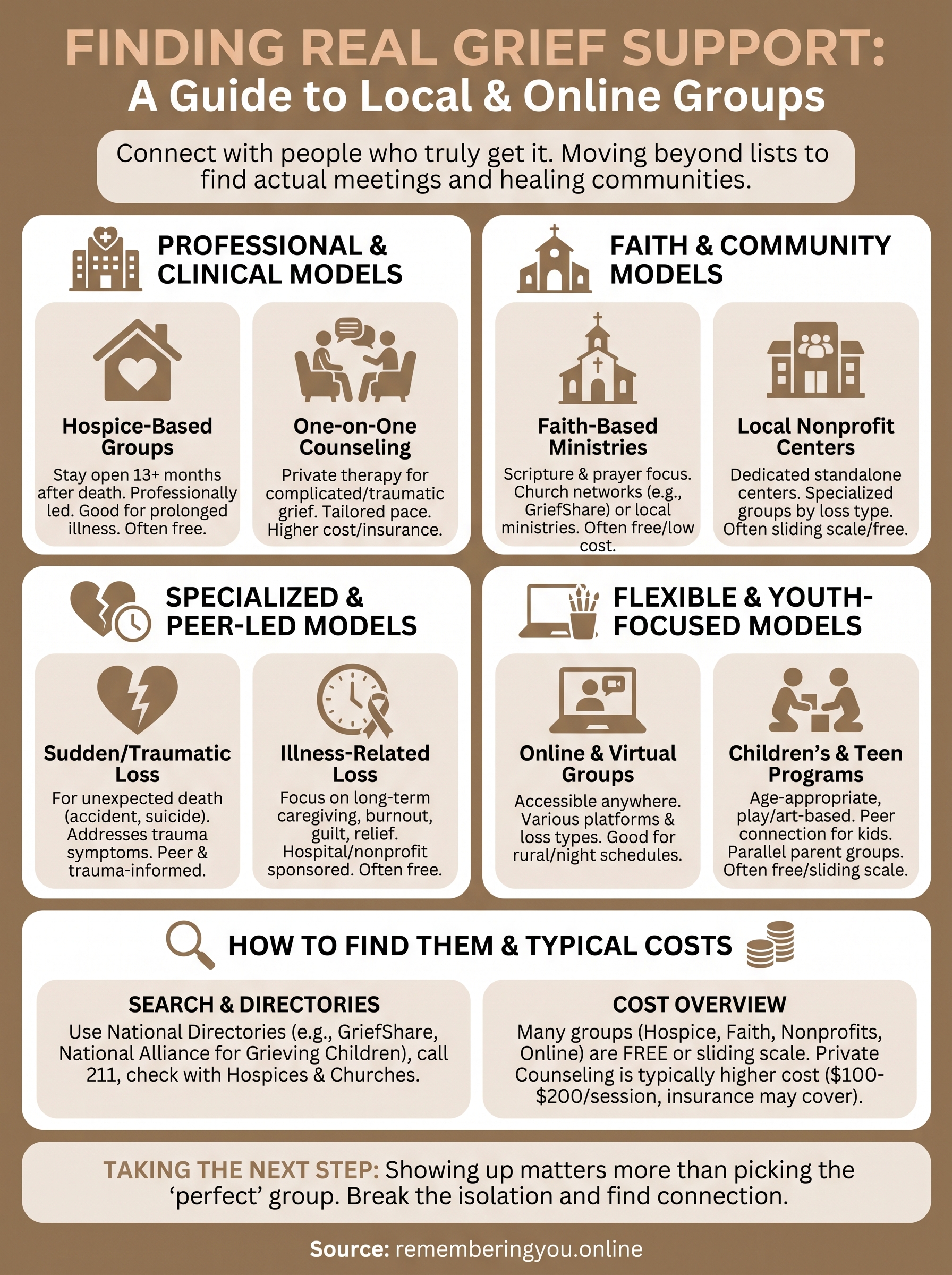
You don't need to pick the perfect option on the first try. Grief support groups near me searches usually turn up more than one workable choice, and trying a hospice group this week doesn't stop you from switching to a nonprofit center or a private therapist next month if it fits better. What matters is showing up somewhere, because isolation is what makes grief harder to carry, not the type of chair you're sitting in.
Once you've found people who understand what you're going through, you'll likely want a way to keep your loved one's memory close between meetings, something more permanent than a group chat or a folder of old photos. That's exactly what a free memorial page gives you: a shared space where family and friends can add stories, photos, and messages long after the funeral flowers are gone. Build a memorial page with a photo gallery, life timeline, and guestbook today, and give the people who loved them a place to keep remembering.