
Memorial QR Code: What It Is and How to Get One
Standing at a headstone and wishing you could hear that person's voice again, or see the photos that never made it into a frame, is a common ache. A memorial qr code solves that problem by linking a small, permanent marker on a headstone, plaque, or urn to a full online tribute page, complete with photos, videos, and stories that a name and two dates can never capture.
If you're searching for this, you probably want to know exactly how it works, what it costs, and where to actually get one. In short: you create a digital memorial page for your loved one, generate a QR code tied to that page, and place the code somewhere visible, on a headstone, a memorial card, or even a garden marker. Anyone with a smartphone camera can scan it and instantly land on the tribute.
This article walks through what a memorial QR code actually is, how the technology works behind the scenes, and a side-by-side look at providers, including free options versus paid engraving services, so you can pick the right setup without overpaying for something you could build yourself in twenty minutes.
Why a memorial QR code means more than a plaque
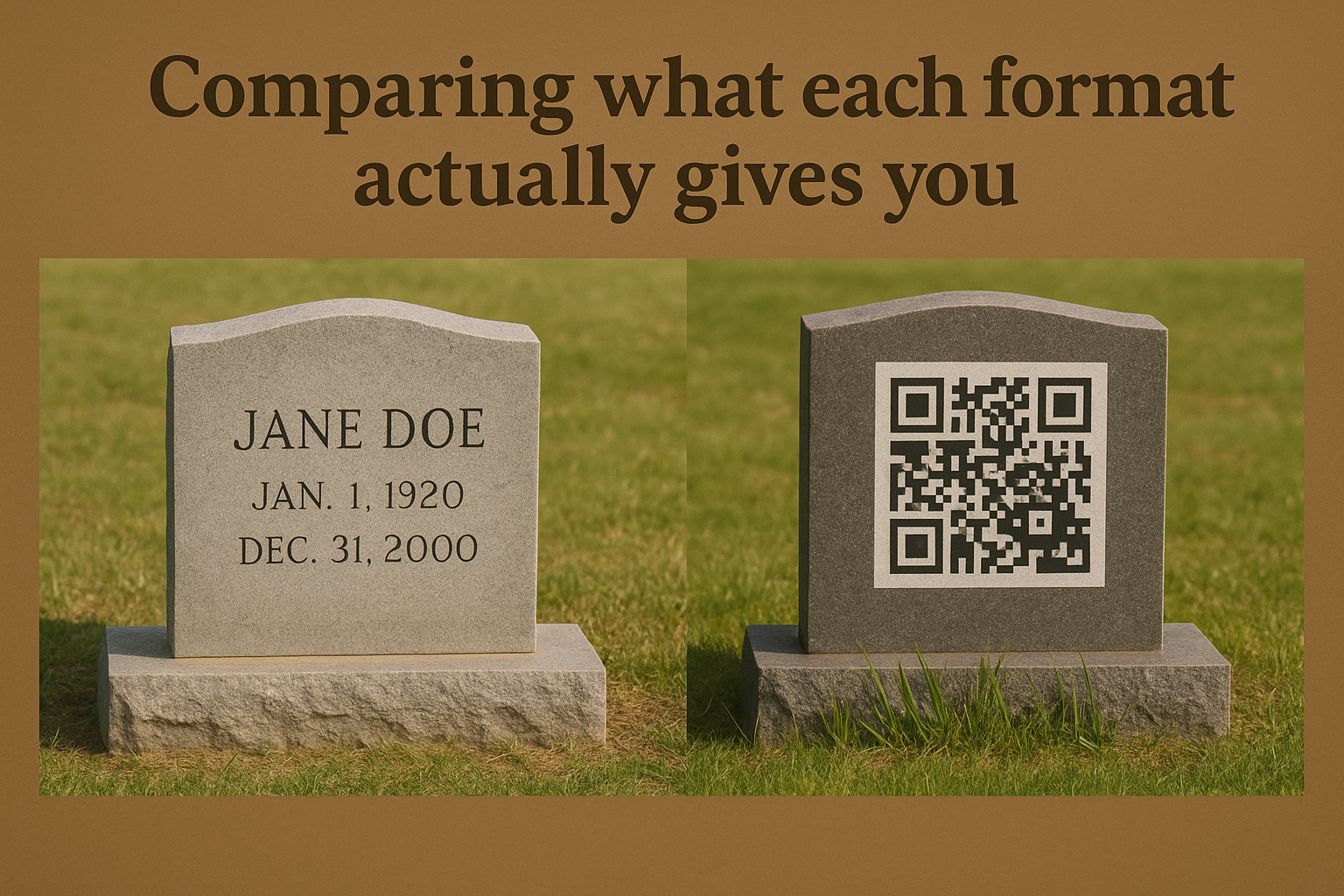
A headstone gives you a name, two dates, and maybe a short epitaph. That's it. A memorial QR code turns that limited stone into a doorway. Scan it, and instead of a few carved words, you get a full online memorial page with photos from every decade of someone's life, videos of their laugh, and stories from people who loved them. The plaque becomes a physical anchor, but the actual memory lives somewhere far bigger.
A headstone tells you who someone was in two dates. A memorial QR code tells you who they were in a hundred photos and a hundred voices.
A headstone can't hold a life story
Engraving is expensive and permanent in the worst way. Once it's carved, you can't add a new photo when a grandchild finds an old letter, and you can't fix a typo without paying a stonemason again. A digital memorial page doesn't have that problem. Families keep adding to it for years: a video from a wedding toast, scanned letters, a recipe card in Grandma's handwriting. The QR code stays the same size on the stone, but what's behind it keeps growing.
Reaching family scattered across the world
Most families aren't in one town anymore. A daughter in Seattle, a brother in London, cousins in Manila, none of them can visit the cemetery on the anniversary of a passing, but every one of them can open a link. This matters most for geographically dispersed families who used to rely on someone mailing physical photos or forwarding a slideshow nobody could open. With a shared tribute page, everyone sees the same guestbook, the same timeline, the same photos, at the same time, regardless of time zone.
A plaque doesn't grieve with you
Grief isn't a single event, it's ongoing. A stone plaque is static: it says the same thing on day one and on the twentieth anniversary. A memorial page tied to a QR code is interactive. Visitors can light a candle online, leave a message in the guestbook, or add a memory that the family never knew about. For Catholic and Christian families in particular, a prayer intentions board turns a solitary graveside visit into something communal, where people who couldn't attend the funeral can still participate in remembrance.
Comparing what each format actually gives you
Laid out side by side, in a straight digital memorial vs traditional headstone comparison, the gap between a plaque alone and a plaque paired with a QR code becomes obvious:
| Feature | Headstone alone | Headstone + memorial QR code |
|---|---|---|
| Content capacity | A name, dates, short epitaph | Unlimited photos, videos, life story |
| Cost to update | Re-engraving fee each time | Free, edit anytime online |
| Accessible from abroad | No | Yes, from any smartphone |
| Interactive elements | None | Guestbook, candles, prayer board |
| Shareable with family | Must visit in person | Shareable link, anywhere |
It bridges the physical and digital worlds
Something about scanning a code at the actual gravesite, connecting a physical grave to a digital tribute, rather than searching a name online later, feels different. It respects the ritual of visiting while adding the depth that a visit alone can't provide. That's the real value of a memorial QR code: it doesn't replace the headstone, it completes it. Families who set one up through a free service like Remembering You often say the plaque becomes secondary; the tribute page is where the actual remembering happens, and the code is just the key that unlocks it whenever someone walks by.
How to create a memorial QR code step by step
Getting a working memorial QR code live in under half an hour is realistic if you skip the guesswork. The process breaks into two halves: building the memorial website the QR code links to, and generating the code itself. Most people overthink the second half when the real work is in the first, since a QR code is only as good as the tribute page behind it.
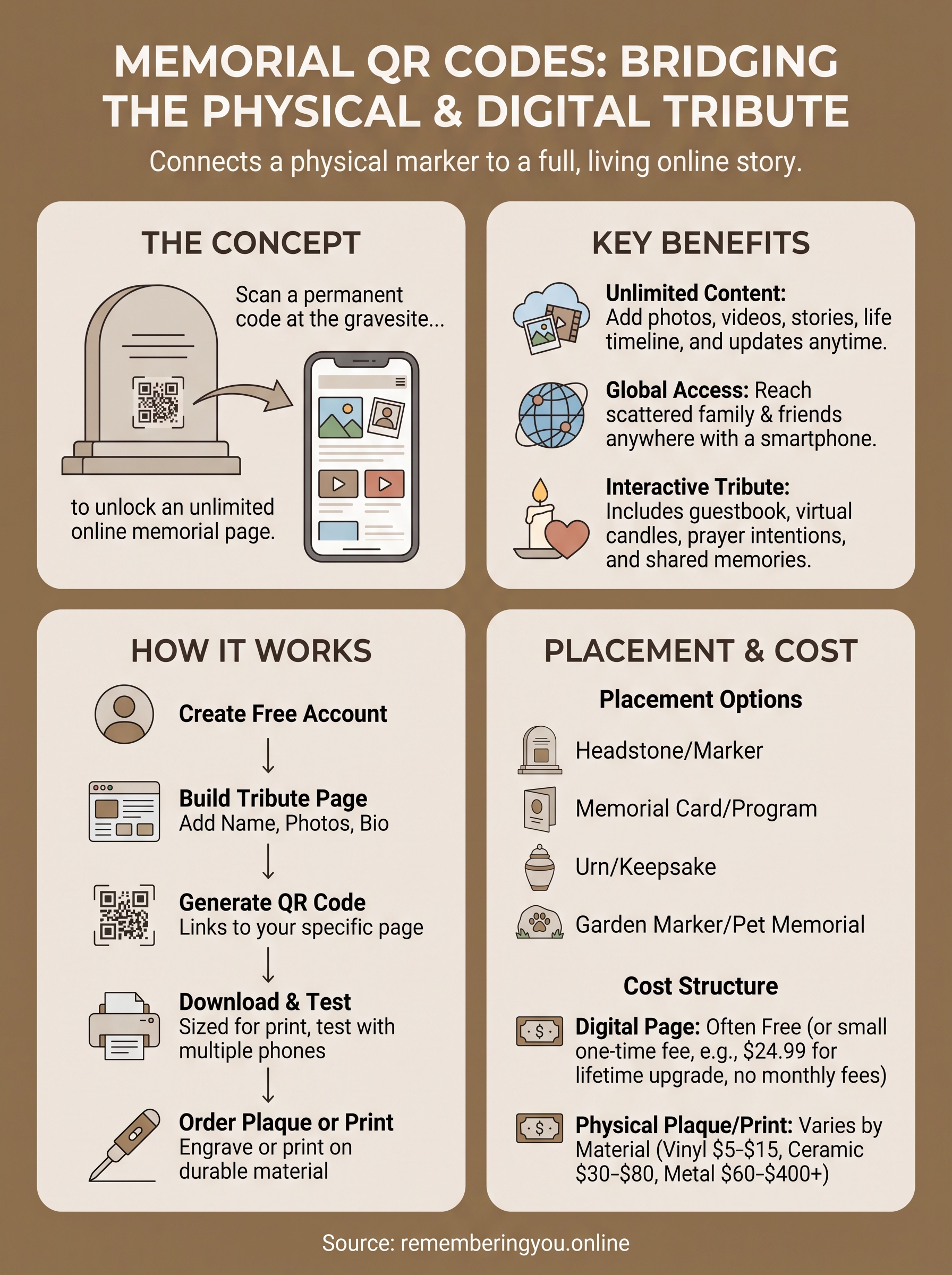
The five steps from account to engraving
Here's the order that actually works, based on how families set up pages on platforms like Remembering You:
- Create a free account on a memorial page platform. No credit card is needed to start, and you can build the full page before deciding whether to pay for anything.
- Build the tribute page first: add a name, dates, a short biography, and at least five to ten photos. The page needs real content before the code is worth generating.
- Generate the QR code tied to that specific page's URL. Most platforms, including Remembering You, create this automatically once the page is published, so you never touch a separate QR generator.
- Download the code as an image file (usually a PNG or SVG) sized for printing, not just screen viewing.
- Send the file to an engraver or plaque maker, or print it yourself onto a weatherproof label if you're placing it somewhere less permanent, like a memorial card.
Test before you print
Don't skip testing. Print the code at actual size on regular paper first, then scan it with three or four different phones, ideally a mix of iPhone and Android, before sending anything to an engraver. A code that scans fine on a screen can fail once it's shrunk down and etched into metal or granite.
A QR code that only works on your phone isn't finished, it's untested.
Sizing matters more than most people expect. A code smaller than about 1.5 inches square often fails outdoor scans in bright sunlight, since phone cameras struggle to read fine detail at a distance in glare. Aim for at least 2 inches square if the plaque will sit on a headstone people view from a few feet away, and always leave a plain white or light border around the code, since engravers sometimes crop too close and clip the corner squares the scanner needs to lock onto.
What to include on your online memorial page
Once the code is generated, everything depends on what it points to. A memorial QR code that leads to a thin, half-finished page wastes the moment someone takes to scan it. Build a beautiful memorial page first, then think about the code as the last step, not the first.
Start with the essentials
Getting the basics right matters more than adding every possible feature on day one. Every strong digital memorial page needs:
- Full name, birth date, and date of passing
- A clear, high-quality profile photo
- A short biography, three to five paragraphs covering where they grew up, their work, and what mattered to them (the same structure used for writing a meaningful obituary)
- Relationship context (parent, spouse, sibling, friend) so distant relatives understand who they're viewing
A memorial page without a biography is just a photo album. The story is what makes people stay.
Build a life timeline, not just a bio
Biographies flatten a life into a summary, but a feature that lets you build a life timeline moves visitors through decades: childhood, military service, a wedding, grandchildren, retirement. Listing milestones chronologically gives people, especially younger relatives who never met the person, a real sense of the arc of their life rather than a single paragraph of highlights.
Add photos and videos that show personality
Five to ten photos is a reasonable minimum, but as most creative photo tributes show, the ones that matter aren't always the formal portraits. Include candid shots, a video clip of them laughing or telling a story, and if you have it, audio of their voice. These small details are what people search for most when they scan a code standing at a headstone, and they're exactly what a stone can never hold.
Make it interactive with guestbook and remembrance tools
Interactivity is what separates a static webpage from a living tribute. A shared memorial guestbook lets visitors leave memories the family never knew about. For Catholic and Christian families, a prayer intentions board and virtual candles give people a way to participate in remembrance even from another country. Every comment or lit candle adds another layer the next visitor will see.
Decide who can see it
Privacy settings shouldn't be an afterthought. Some families want a fully public page anyone can find; others prefer a password-protected memorial page shared only with close relatives. Platforms like Remembering You let you set this per page, so you can open it to the community for a funeral service, then lock it down afterward if that feels right.
Where to place a memorial QR code
A memorial QR code only works if people actually find it, so placement matters almost as much as the page behind it. The most common spot is the headstone itself, but plenty of families choose somewhere softer, more personal, or easier to update than granite. Think about who will encounter the code and where they'll naturally be standing with a phone in hand.
On the headstone or grave marker
Engraving a headstone QR code directly onto the stone, or onto a small brass or ceramic plaque mounted to it, is the most permanent option. Cemeteries have different rules about additions to existing monuments, so check with the cemetery office or your monument company before ordering anything. Most allow a small attached plaque even if they restrict new engraving on the stone face.
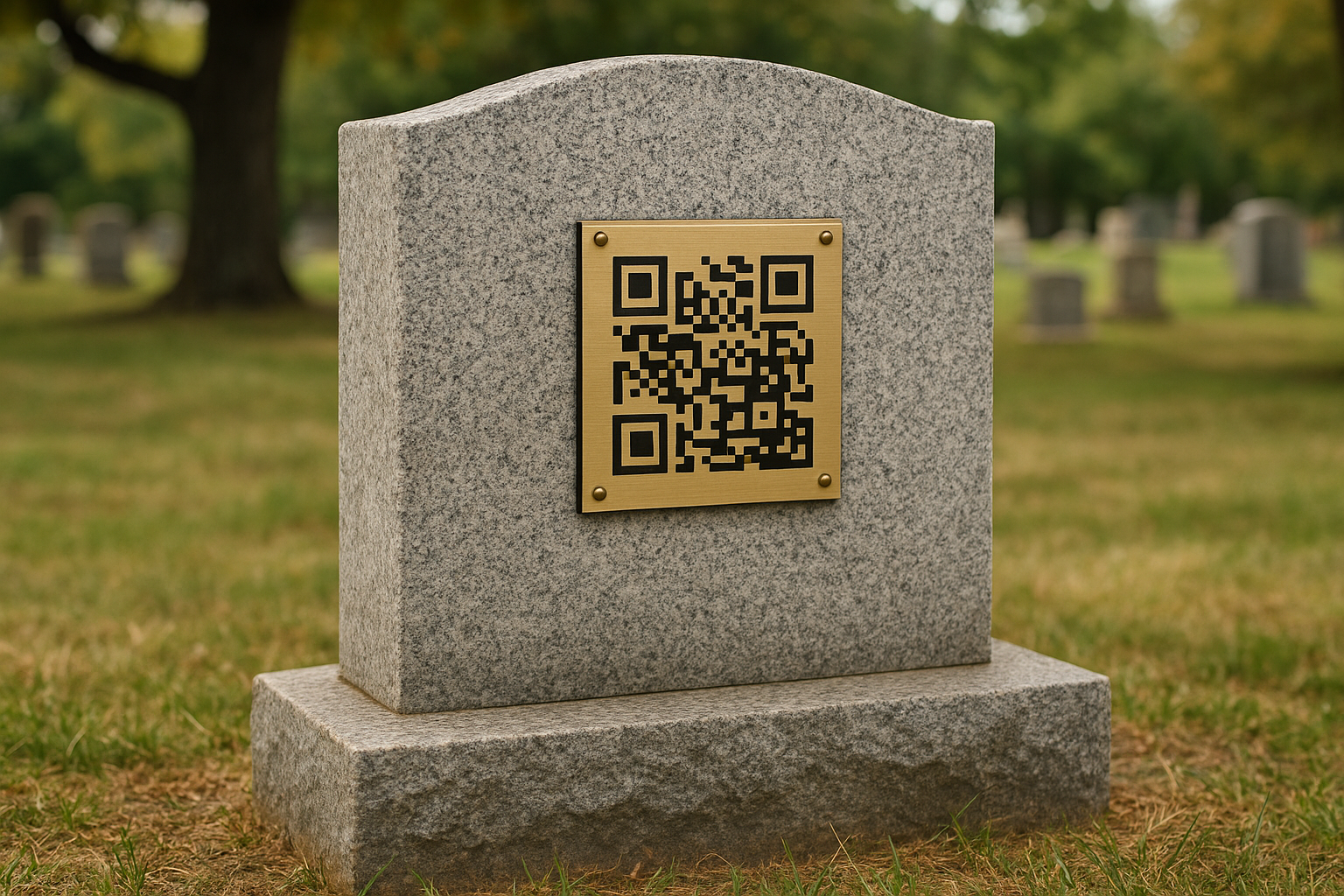
The best spot for a memorial QR code is wherever someone is already standing still, thinking about the person.
On a memorial card or funeral program
Printing the code on funeral programs, prayer cards, or thank-you notes puts it directly into the hands of everyone who attends the service. This works well for guests who can't visit the cemetery but want to revisit photos and the guestbook later from home. It's also the cheapest placement option since it costs nothing beyond ink and paper.
At home, in a memory garden, or on an urn
Not every family buries a loved one, and not every tribute lives in a cemetery. A QR code plaque works just as well on:
- A cremation urn or keepsake box kept at home
- A garden stone or planter marker in a memory garden
- A frame alongside a photo on a mantel or shelf
- A bench or tree marker in a park the person loved
On a pet memorial
Families creating a pet memorial page often skip the cemetery entirely and place the code on a small marker in the backyard, on a collar tag kept as a keepsake, or on a paw-print stone near a garden. Pet memorials get scanned just as often as human ones, usually by kids or grandkids who want to see old photos of a dog or cat long after it's gone. Wherever you place it, keep the surface flat and the code away from constant direct sun exposure, since glare and weathering both make scanning harder over time.
Choosing a durable QR code plaque material
A QR code plaque sitting outside for twenty years faces sun, rain, frost, and lawnmower grit, so the material you pick determines whether that code still scans a decade from now. Cheap laminated paper or a sticker meant for indoor use will fade and peel within a year or two outdoors, leaving family members standing at a headstone with a dead phone camera and no working link. Picking the right material upfront costs a little more but saves you from redoing the whole plaque later.
A memorial QR code is only as permanent as the material it's printed on.
Metal plaques for outdoor permanence
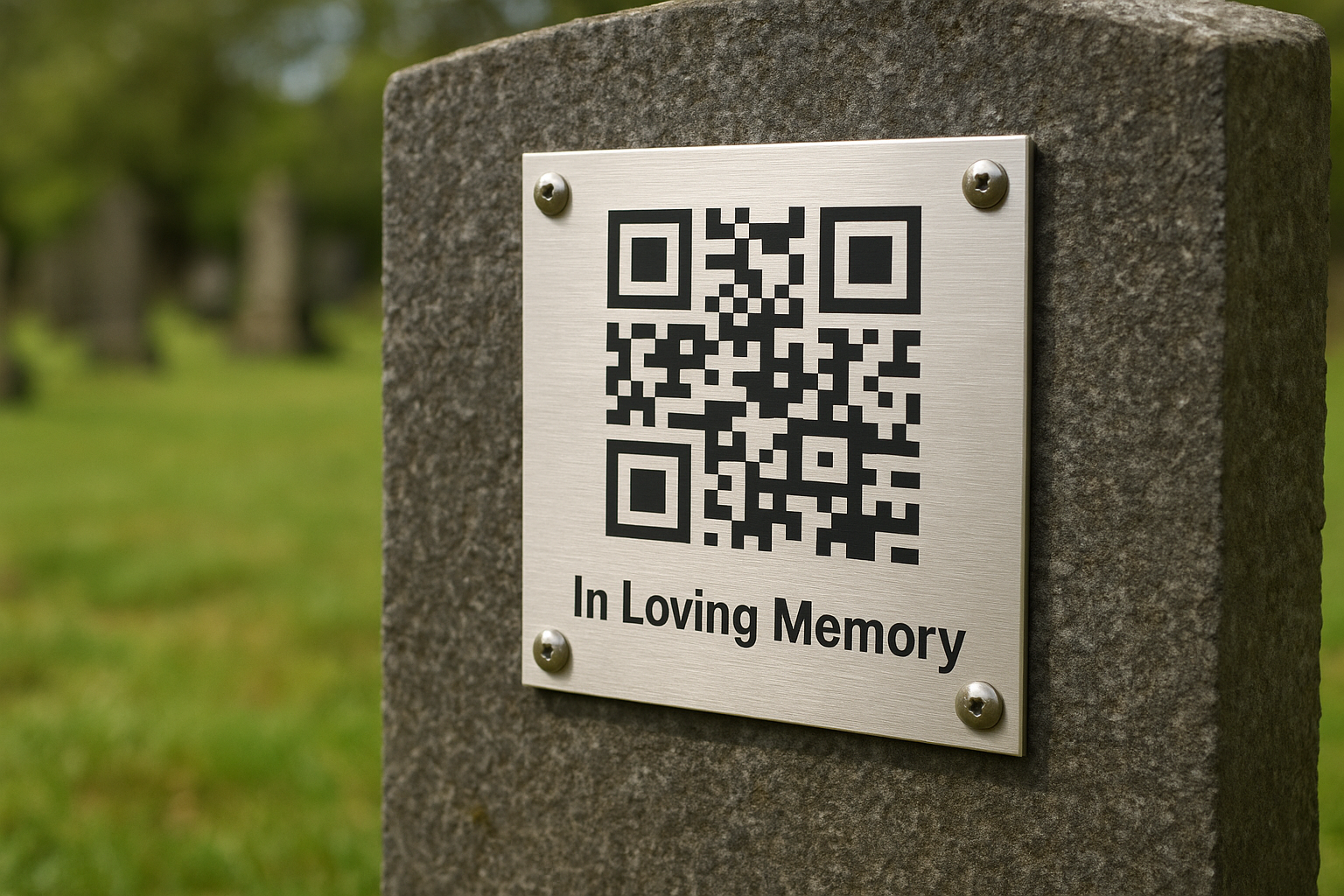
Stainless steel and anodized aluminum hold up best against weather, and both accept laser engraving that etches the code directly into the metal rather than printing on top of it. Because the pattern is physically cut in, there's no ink to fade and no coating to peel. Bronze is another traditional choice cemeteries already allow, though it costs more and darkens with age, which can actually reduce contrast and hurt scannability if the patina isn't managed.
Ceramic and porcelain for a traditional look
Ceramic plaques fire the QR code onto a glazed surface, giving a clean, glossy finish that matches the look of older porcelain photo memorials already common on headstones. Glazed ceramic resists UV fading well, but it's brittle, so it's a poor choice anywhere it might get knocked by mowing equipment or foot traffic near the grave.
Weatherproof vinyl for cards, urns, and temporary markers
Vinyl works fine for indoor placements like an urn, a memory garden marker under cover, or a keepsake box on a shelf. Look specifically for UV-rated, laminated vinyl if it's going anywhere outside even part-time, since standard adhesive labels degrade within months in direct sun.
| Material | Durability outdoors | Typical cost | Best placement | |---|---|---| | Stainless steel/aluminum | 20+ years | $$ | Headstone, monument | | Bronze | 20+ years | $$ | Headstone, cemetery plaque | | Ceramic/porcelain | 10-15 years | $ | Headstone, indoor niche | | Weatherproof vinyl | 2-5 years outdoors | $ | Cards, urns, indoor markers |
Whichever material you choose, ask the engraver for a proof print at final size before production runs, since a code that looks sharp on a screen can still lose the fine detail a scanner needs once it's shrunk onto a small plaque.
How much a memorial QR code costs
Costs split into two completely separate buckets: what you pay for the online memorial page itself, and what you pay to physically produce the plaque or card that carries the code. Confusing the two is where most people overspend, since some companies bundle a subscription fee into what should be a one-time plaque purchase. Understanding each piece separately lets you build exactly the setup you need without paying for extras you won't use.
The digital page: often free, sometimes a small one-time fee
Building the tribute page and generating the QR code costs nothing on a platform like Remembering You, where a free account lets you create the full page, add photos and a biography, and download the code with no credit card required. If you want extras like unlimited photo storage, video uploads, or advanced privacy controls, a one-time lifetime upgrade runs $24.99 on Remembering You, with no recurring subscription ever. That's a sharp contrast to competing memorial platforms that charge monthly or yearly fees indefinitely, which can add up to hundreds of dollars over a decade for something a one-time payment already covers.
Pay once for the page, and never again. A memorial shouldn't come with a monthly bill.
The physical plaque: where the real cost variation shows up
Plaque and engraving costs vary widely depending on material and where you order it. A monument company adding a small metal plaque to an existing headstone typically charges more than a print shop producing a vinyl label for a memorial card, since labor and material both scale with durability.
| Item | Typical cost range |
|---|---|
| Digital memorial page (free tier) | $0 |
| Lifetime upgrade (Remembering You) | $24.99 one-time |
| Printed vinyl QR code label | $5-$15 |
| Ceramic or porcelain plaque | $30-$80 |
| Stainless steel/aluminum plaque, engraved | $60-$150 |
| Bronze cemetery plaque | $150-$400+ |
Skip the middlemen charging monthly fees
Some standalone "memorial QR code" companies charge a setup fee plus an ongoing subscription just to keep the linked page online, and if you stop paying, the code on the headstone stops working. That's a real risk for something meant to last decades. Weighing free versus paid memorial websites and choosing a free or one-time-fee platform for the page, then handling the plaque separately through any local engraver, keeps you in control of both costs and avoids a dead QR code down the road because a bill went unpaid.
Keeping their story just a scan away
A memorial qr code costs little, takes less than an hour to set up, and does something a headstone alone never could: it keeps a life story growing long after the stone is carved. Photos, videos, guestbook entries, and prayer intentions all stay one scan away, reachable by anyone standing at the grave or sitting halfway across the world. Building the page matters more than picking the fanciest plaque, since the code is only as good as what it links to.
Start with the page, not the metal. Create a free account, add the photos and stories that actually capture who someone was, and only then order a plaque or print a card. If you're ready to begin, start a free memorial page on Remembering You and get a printable memorial QR code that keeps their story just a scan away, for as long as anyone still wants to find it.