
Grief and Counseling: What It Is and How to Find Help
Losing someone doesn't come with an instruction manual, and if you're searching for answers right now, you're probably exhausted, foggy, and not sure where to turn next. Grief and counseling often get mentioned in the same breath because talking to someone trained in loss can make the weight feel a little more manageable, whether that's one-on-one therapy or a room full of people who understand exactly what you're going through.
If you typed in free grief counseling groups near me, you're probably hoping for something specific: local options in Phoenix, AZ, that won't cost you a dime and won't require you to explain your loss from scratch every session. That's exactly what this article walks through, along with what grief counseling actually involves and how it differs from just "talking it out" with friends.
We'll cover the types of counseling available, how to find low-cost or free support groups in your area, and what to expect from your first session. We'll also touch on how creating a lasting tribute, like a memorial page for the person you lost, can work alongside counseling as part of your healing process.
Why grief counseling matters for healing
Grief doesn't follow a straight line, no matter what the five stages of grief taught you to expect. Grief and counseling work well together precisely because a trained therapist understands that bargaining can show up after acceptance, that anger can resurface on a random Tuesday eighteen months later, and that none of this means you're doing it wrong. Left alone with these swings, a lot of people start to believe something is broken in them. A counselor's first job is often just naming what's normal, which takes an enormous amount of pressure off.
Unprocessed grief doesn't just sit quietly in the background either. Research from the National Institute of Mental Health links prolonged, unsupported grief to higher rates of depression, anxiety, sleep disruption, and even cardiovascular strain. Your body keeps score even when you're telling everyone you're "doing okay." Counseling gives that stress somewhere to go instead of festering as insomnia, appetite changes, or snapping at people you love for no clear reason.
Grief counseling doesn't erase the pain of loss, it teaches you how to carry it without it crushing everything else in your life.
Support from friends and family matters, don't get me wrong. But friends often want to fix things or steer you toward feeling better faster than you're ready for, sometimes without meaning to, which is why knowing what actually helps a grieving person is its own skill. A trained grief counselor doesn't need you to be okay by a certain date. They're not grieving alongside you, which means they can hold space for the messy, non-linear parts without their own emotions getting tangled into yours. That distinction alone is why so many people find professional support does something a support network of loved ones simply can't.
The isolation factor
Loss tends to shrink your world. People stop calling because they don't know what to say, invitations dry up, and you're left feeling like you're the only person who's ever hurt this much. Grief groups directly counter that isolation by putting you in a room, physical or virtual, with people who don't flinch when you mention the person you lost. Hearing someone else describe the exact same 3 a.m. panic you've been having is often the first moment a grieving person feels less alone in months.
Practical benefits counseling provides
Beyond emotional support, structured grief counseling gives you tools you can actually use between sessions. Here's what that typically looks like:

- Coping strategies for grief triggers like anniversaries, holidays, or hearing a specific song
- Communication scripts for talking to kids about death, coworkers, or extended family about your loss
- Screening for complicated grief, a condition where mourning symptoms persist intensely for a year or more and may need specialized treatment
- Referrals to psychiatrists, support groups, or additional resources if grief overlaps with depression or trauma
- A judgment-free space to say the things you can't say to family, like relief, guilt, or anger at the person who died
These tools matter because grief isn't just an emotional experience, it's a full-body, full-life disruption. Counseling addresses the practical fallout, not just the feelings underneath it. Working through both pieces together tends to produce steadier, longer-lasting relief than either approach on its own.
Signs it may be time to seek grief counseling
Grief doesn't come with a checklist telling you when to call for help, so a lot of people wait far longer than they need to. Recognizing the signs early can save you months of unnecessary suffering, especially if you've been telling yourself you should just push through on your own. Watching for a few specific patterns in your daily life is usually more useful than trying to measure grief against some imaginary timeline.
Everyday signs worth paying attention to
Some signals are subtle enough that friends and family might miss them, even though you notice them every day. Consider whether any of these describe your last few weeks:
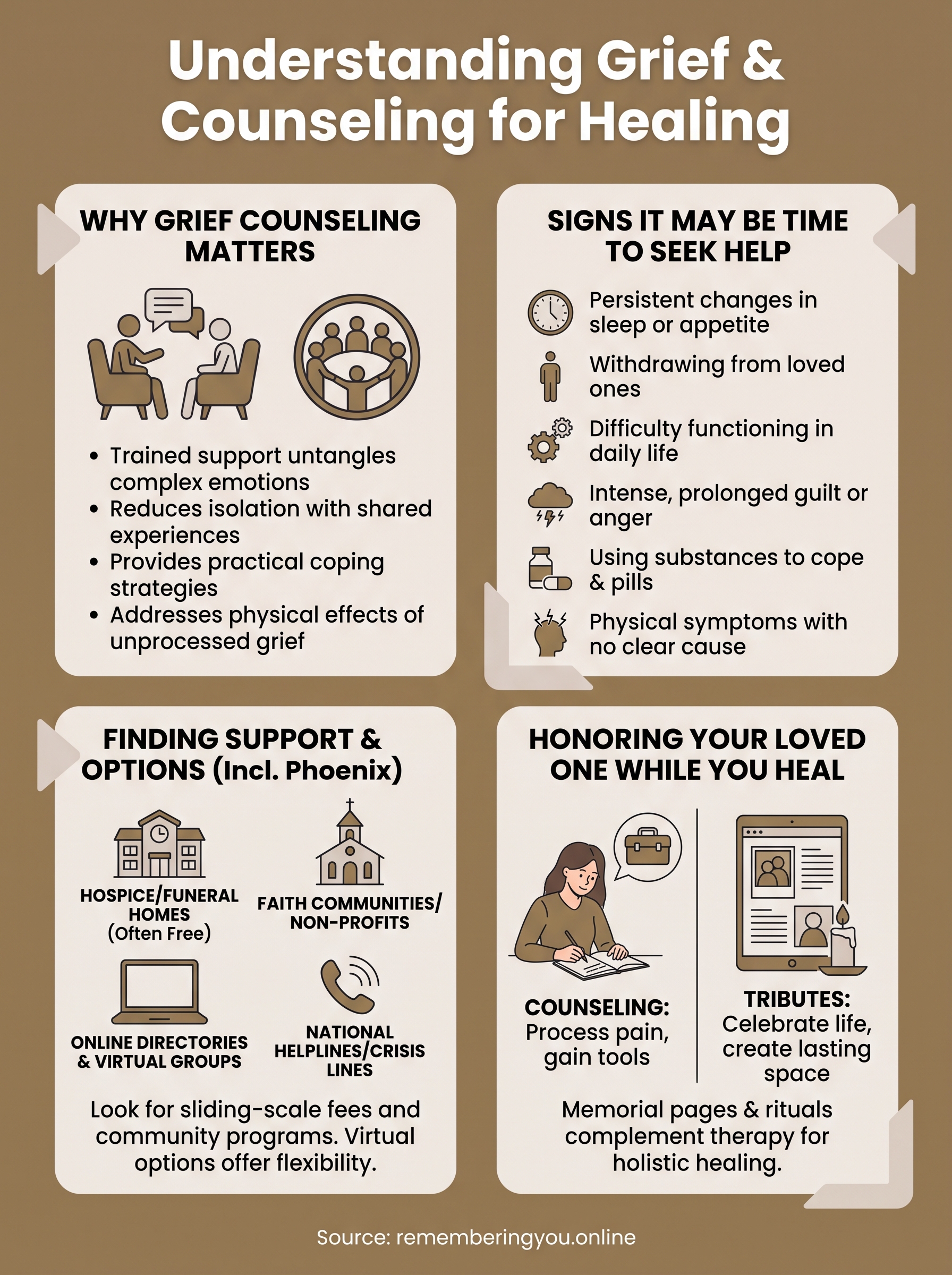
- Sleep or appetite changes that have lasted more than a few weeks without improving
- Withdrawing from people you used to enjoy spending time with, even ones who genuinely care about you
- Difficulty functioning at work, school, or with basic daily tasks like laundry or paying bills, which often surfaces when you're going back to work after a death
- Intense guilt or anger that feels disproportionate or won't ease up over time
- Using alcohol or other substances more frequently to numb the pain
- Physical symptoms like chest tightness, headaches, or exhaustion that don't have another clear cause
Any one of these on its own might just be a rough week. Several of them together, stacked over a month or more, usually means your grief needs more support than it's currently getting.
When grief starts to feel stuck
One particular red flag deserves its own mention: complicated grief, sometimes called prolonged grief disorder. This is when the intensity of mourning doesn't ease at all after twelve months, and you find yourself just as raw as you were in the first weeks after the loss. Therapists trained in loss can screen for this specifically, because complicated grief often responds to targeted treatment approaches that general talk therapy doesn't fully address.
If a year has passed and the pain hasn't softened at all, that's not weakness, that's your signal to reach out for professional grief counseling.
Another sign is thinking about the person who died in ways that interfere with daily life, like avoiding anything that reminds you of them so completely that you've stopped leaving the house. Trusting your gut matters here. If something feels off, even if you can't name exactly what, that instinct is worth acting on rather than dismissing. Waiting for things to get unmistakably bad before seeking grief and counseling support usually means waiting longer than you have to.
How to find grief counseling and support groups near you
Starting your search can feel overwhelming when you're already stretched thin, so narrow it down by picking one method first instead of trying everything at once. Online directories like Psychology Today's therapist finder let you filter by location, insurance, and specialty, so you can search specifically for "grief" or "bereavement" counselors within a few miles of your zip code. Most directories list session rates and whether a provider offers sliding-scale fees, which matters if cost is a factor in your decision.
Hospitals and hospice organizations often run free grief support programs, even for people whose loved one wasn't a hospice patient. Many hospices open their bereavement groups to the wider community as a form of outreach, so it's worth calling your local hospice directly and asking, rather than assuming their services are limited to former clients. Funeral homes frequently keep referral lists too, since aftercare support is part of how they serve families long after the service ends.
The right support is often closer than you think, a single phone call to a local hospice or funeral home can open doors you didn't know existed.
Where to start looking
Use this list as a starting point when you're not sure who to call first:
- Local hospitals and hospice organizations, many offer free community bereavement groups
- Funeral homes, ask directly for aftercare referral lists
- Faith communities, churches and parishes often host grief ministries open to the public
- Community mental health centers, which frequently use sliding-scale fees based on income
- National organizations like GriefShare or The Compassionate Friends, which list local chapter meetings by zip code
- Employee assistance programs (EAPs), if you're employed, since many include a set number of free counseling sessions
Checking a few of these sources at once usually turns up more options than searching a single directory alone.
Virtual support deserves consideration too, especially if mobility, scheduling, or transportation makes in-person meetings hard. Video-based grief groups run by national nonprofits connect you with facilitators and peers regardless of state lines, which matters if you live somewhere with thin local resources, and there are more free digital grief counseling options than most people expect. Combining a local option with an online group isn't unusual either. Some people prefer the anonymity of a virtual room for the hardest conversations, then use in-person meetings for the sense of physical presence that video can't quite replicate. Neither format is objectively better, so pick whichever one you're more likely to actually show up for consistently.
Types of grief therapy and which approach fits you
Not every grieving person needs the same kind of help, and picking a therapy style that matches your personality can make the difference between sticking with counseling and quitting after one awkward session. Grief and counseling come in several formats, from one-on-one talk therapy to structured group programs, and knowing the differences upfront saves you from trial and error during an already exhausting time.
Individual vs. group therapy
Individual therapy gives you a private space to process guilt, anger, or complicated family dynamics you might not feel comfortable sharing in a room full of strangers. Group therapy, on the other hand, offers something individual sessions can't: proof that you're not the only one whose grief looks messy or takes longer than expected. Many people benefit from combining both, using individual sessions for the heavier personal material and groups for the sense of shared experience.
Choosing the right therapy format matters less than choosing one you'll actually show up to week after week.
Comparing common approaches
Here's a quick breakdown of the main options you'll run into while searching:

| Approach | Best for | Format |
|---|---|---|
| Cognitive Behavioral Therapy (CBT) | Grief tangled with anxiety or depression | Individual, weekly |
| Complicated Grief Treatment (CGT) | Grief that hasn't eased after 12+ months | Individual, structured protocol |
| Peer support groups | Feeling isolated, wanting shared experience | Group, in-person or virtual |
| Family or couples grief counseling | Losses affecting an entire household | Joint sessions |
| Faith-based grief ministries | Families wanting spiritual framing alongside support | Group, community-based |
CGT deserves a specific mention here because it's a targeted protocol, not just general talk therapy, and it's shown strong results for people stuck in prolonged grief that hasn't budged. If your grief has stayed just as intense as it was in the first weeks, ask a provider specifically whether they're trained in CGT rather than assuming standard counseling will address it.
Spiritual and cultural fit matters too. Catholic and Christian families often gravitate toward grief ministries that incorporate prayer, scripture, or communal mourning practices alongside clinical support, and there's nothing wrong with prioritizing that fit over a purely secular approach. Pet loss also deserves its own consideration, since some therapists specialize specifically in that grief and understand it doesn't rank lower just because the loved one had four legs, and ways to honor a beloved pet can sit alongside that support. Matching the approach to your actual needs, rather than picking whatever's most convenient, tends to produce better results over time.
What to expect in a grief counseling session
Walking into a first session, most people feel a mix of relief and dread, and that's completely normal. Grief and counseling sessions rarely look like the dramatic therapy scenes you've seen on TV. There's no couch you lie on while a therapist scribbles notes in silence. Instead, expect a conversation, guided but not scripted, where the counselor asks questions to understand who you lost, how the loss happened, and what your support system looks like right now.
The first session
Your opening appointment usually runs longer than later ones, often 60 to 90 minutes, because the counselor needs background before they can help. Expect questions like these:
- How did your loved one die, and how much warning did you have
- What does your support network look like outside this room
- Are you sleeping, eating, and functioning at work or school
- Have you had thoughts of self-harm or feeling like life isn't worth continuing
- What are you hoping counseling will help with specifically
That last question matters more than it sounds. Naming a goal, even something as simple as "I want to sleep through the night again," gives the counselor a way to measure progress instead of just checking in vaguely week after week.
A good grief counselor isn't there to fix you, they're there to walk beside you while you figure out how to carry this.
What happens in later sessions
Zeroing in on specific triggers tends to happen once the counselor has a full picture of your situation. Sessions might focus on an upcoming anniversary, a strained conversation with a sibling about splitting up belongings, or the guilt that shows up out of nowhere on an ordinary Wednesday. Homework sometimes gets assigned too, things like journaling prompts or a specific breathing exercise for panic moments, though nobody's grading you if you skip it during a hard week.
Group sessions look different from individual ones. Expect a facilitator who opens with a check-in round, then lets the conversation flow naturally rather than forcing everyone to speak on cue. You're never required to share more than you're comfortable with, and simply listening to others counts as participation.
Questions about pacing come up constantly, and there's no fixed answer. Some people need six sessions, others need a year or more, and neither timeline means you're doing grief wrong. Trusting the process, even when it feels slow, tends to serve people better than rushing toward some arbitrary finish line.
Free and low-cost grief support options in Phoenix
Phoenix has more free grief resources than most people realize, you just have to know which door to knock on first. Hospice of the Valley, one of the largest hospice providers in the Valley, runs community bereavement groups open to anyone in the area, not just families of former patients, and they offer both in-person and phone-based support at no cost. Calling their bereavement line directly is usually faster than searching their website, since group schedules shift based on demand and season.
Catholic and Christian families searching specifically for free grief counseling groups near me often find a good fit through Catholic Charities Community Services, which offers grief support alongside its broader counseling programs on a sliding scale, meaning cost adjusts based on what you can actually afford. Several Valley parishes also run their own grief ministries that combine peer support with prayer, and these are typically open to the wider community regardless of parish membership.
You don't need a referral, insurance, or a diagnosis to walk into a free grief group, you just need to make the call.
Where Phoenix-area resources tend to cluster
A few categories consistently show up when you start calling around the Valley:
- Hospice of the Valley bereavement services, open community-wide, no prior hospice relationship required
- Catholic Charities Community Services, sliding-scale grief counseling and support groups
- A New Leaf, a Valley nonprofit offering counseling services on a sliding fee scale
- Crisis Response Network, which can point you toward same-day mental health resources if grief has become urgent
- Maricopa County community mental health centers, income-based fees for individual grief counseling
- Local GriefShare and Compassionate Friends chapters, both run active Phoenix-area meetings listed by zip code
Structured programs help, but sometimes the need is more immediate. If grief has tipped into crisis territory, the SAMHSA National Helpline offers free, confidential support around the clock and can connect you to local Phoenix resources on the spot.
Working through a list like this beats scrolling search results for hours, since most of these organizations will tell you within one phone call whether they have space and what it costs, if anything. Calling two or three options in the same week, rather than waiting for a callback from just one, tends to get you into a group faster.
Honoring your loved one while you heal
Counseling gives you tools to process pain, but healing also needs somewhere to put your love for the person who died. Acts of remembrance work alongside grief and counseling rather than replacing it, giving you a concrete way to celebrate a life instead of only mourning its end. Many therapists actually encourage this pairing, since memorializing someone taps into a different part of the healing process than talk therapy alone.
Creating a lasting tribute
Building a dedicated space for photos, stories, and memories gives scattered family members somewhere to gather even when they live states or countries apart. A free memorial page through Remembering You lets you build a timeline of their life, add photos and videos, and invite relatives to contribute their own memories in a shared guestbook. Families dealing with distance often find this fills a gap that a single funeral service can't, since cousins in another time zone can still light a virtual candle or leave a note whenever grief hits them.

A tribute page doesn't replace grief work, it gives your love somewhere to live once the funeral flowers are gone.
Physical spaces matter too, and this is where the QR code feature becomes genuinely useful rather than gimmicky. Placing a code on a grave marker, memorial card, or photo frame means anyone visiting the grave can pull up the full tribute instantly, photos, stories, and all, right from their phone. For Catholic and Christian families, prayer intention boards built into the page let extended family and church community add prayers long after the funeral mass has ended.
Small rituals that support ongoing healing
Consistent small rituals tend to matter more than one big gesture. Consider these options as you figure out what feels right:
- Updating the tribute page on birthdays, anniversaries, or holidays with new photos or memories, one of many traditions worth repeating each year
- Lighting a virtual candle on hard days when visiting a grave isn't possible
- Sharing the memorial link with family members who couldn't attend the service
- Writing in the memorial guestbook where family leaves messages as a low-pressure way to process feelings between counseling sessions
None of these replace professional support, but they give grief somewhere productive to go on the days between sessions.
Taking the next step toward healing
Grief doesn't resolve on a deadline, and it doesn't respond well to being ignored either. Grief and counseling work together because talking to someone trained in loss gives your pain somewhere productive to go, whether that's a Phoenix hospice group, a sliding-scale therapist, or a national hotline at 2 a.m. when you can't sleep. Pick one option from this article and make the call this week, even if it's just to ask questions and see how it feels.
Support groups and therapy handle the processing, but you'll also want a place to celebrate the life you lost, not just mourn its ending. That's where a tribute page fits naturally alongside your counseling work. Start a free tribute page for your loved one today, add their photos and story, and give family scattered across the country somewhere to gather, grieve, and remember together.