
Guestbook for Funeral: What It Is and How to Choose One
Standing at a funeral home counter, staring at a wall of leather-bound books, you realize you have about ten minutes to pick something that will outlast the flowers and the casseroles. A guestbook for funeral services is where mourners sign their names and leave a few words about the person you lost, and that small record often becomes one of the most reread items in the house months later.
Choosing one comes down to three questions: paper or digital, who needs access, and how long you want it to last. A traditional funeral home guestbook works fine for a single service in one room, but it stops there. A digital guestbook keeps collecting messages from relatives who couldn't fly in, for years instead of just one afternoon.
This article walks through what a guestbook funeral book actually needs to include, compares physical and online formats side by side, and gives you a straightforward way to decide which fits your family, your budget, and your timeline before the service even starts.
Why a guestbook matters at a funeral service
A record of who showed up when grief makes everything blur
Grief has a way of erasing details. You remember the casket, the flowers, maybe the song that played, but names of who actually walked through the door often vanish within days. A funeral home guestbook solves that problem by capturing every visitor in one place, so weeks later you can look back and know exactly who came to support you. Funeral directors will tell you that families almost never regret having a guestbook, but they regret it constantly when one wasn't kept, especially for services with 150 or more attendees where memory simply can't keep pace.
A guestbook is the only part of a funeral that keeps giving you information after the flowers have wilted.
Words that become keepsakes
Beyond names, the short messages people leave turn into some of the most treasured lines in the entire mourning process. A coworker's memory of your father's laugh, a neighbor's note about borrowing tools every summer, a cousin's line about a childhood nickname, these small entries add up to a collective portrait of the person you lost that no eulogy delivered at the service alone can capture. Families often reread these pages during the first anniversary, and the details people write in the moment tend to be more honest and specific than anything gathered later, since memory fades but ink doesn't.
Common entries you'll find in a well-used guestbook for funeral service include:
- A short line about how the visitor knew the deceased
- A specific memory or shared moment
- A word of comfort directed at the family
- Contact information, useful for sending thank-you notes afterward
Comfort for the family in the weeks after
Sitting with a guestbook months after a service gives grieving families something tangible to hold onto during the hardest stretch, the period after the casseroles stop arriving and the phone calls slow down. Reading through condolences again reminds you that you weren't grieving alone, even if it felt that way at 3 a.m. two weeks in. This is where the format starts to matter more than people expect at the funeral home counter: a paper book sits in a drawer and gets pulled out rarely, while a shared digital memorial page stays accessible to the whole family, which is one reason online guestbooks help families long after the service, updated with new memories long after the funeral itself is over. Grief doesn't stop after the burial, and neither should the space where people record how they felt about the person you lost.
How to choose the right funeral guestbook
Selecting a guestbook for funeral services starts with a hard look at your guest list, not the cover material. Ask yourself who actually needs to sign it: just the people in the room, or also the aunt in Australia who couldn't make the flight. That single question rules out half the options on a funeral home's shelf before you even open one.
Match the format to your family's spread
Geography decides more than people expect. A guestbook funeral book made of paper only works if everyone who wants to leave a message can physically attend, and for dispersed families that's rarely true anymore. Consider these factors before deciding:
- How many attendees live outside driving distance
- Whether elderly relatives can write comfortably by hand
- If the family wants entries added after the service, not just during it
- Whether photos or videos should accompany written messages
Choose the format based on who's missing from the room, not just who's in it.
Decide how long the record needs to last
Longevity matters more than most families realize at the funeral home counter. Paper books get water-damaged, misplaced during a move, or simply forgotten in a closet within a few years. A guestbook for funeral service built as an online memorial page you can set up yourself avoids all three problems, staying backed up and reachable from any phone or laptop indefinitely. Platforms like Remembering You let you create that page for free, add a shared guestbook alongside photos and a life timeline, and generate a scannable code that leads back to the memorial for anyone visiting a grave or keeping a memorial card. Once you've weighed room size, geography, and how many years you want the record to survive, the right choice usually becomes obvious rather than a coin flip at the display case.
Types of funeral guest books to consider
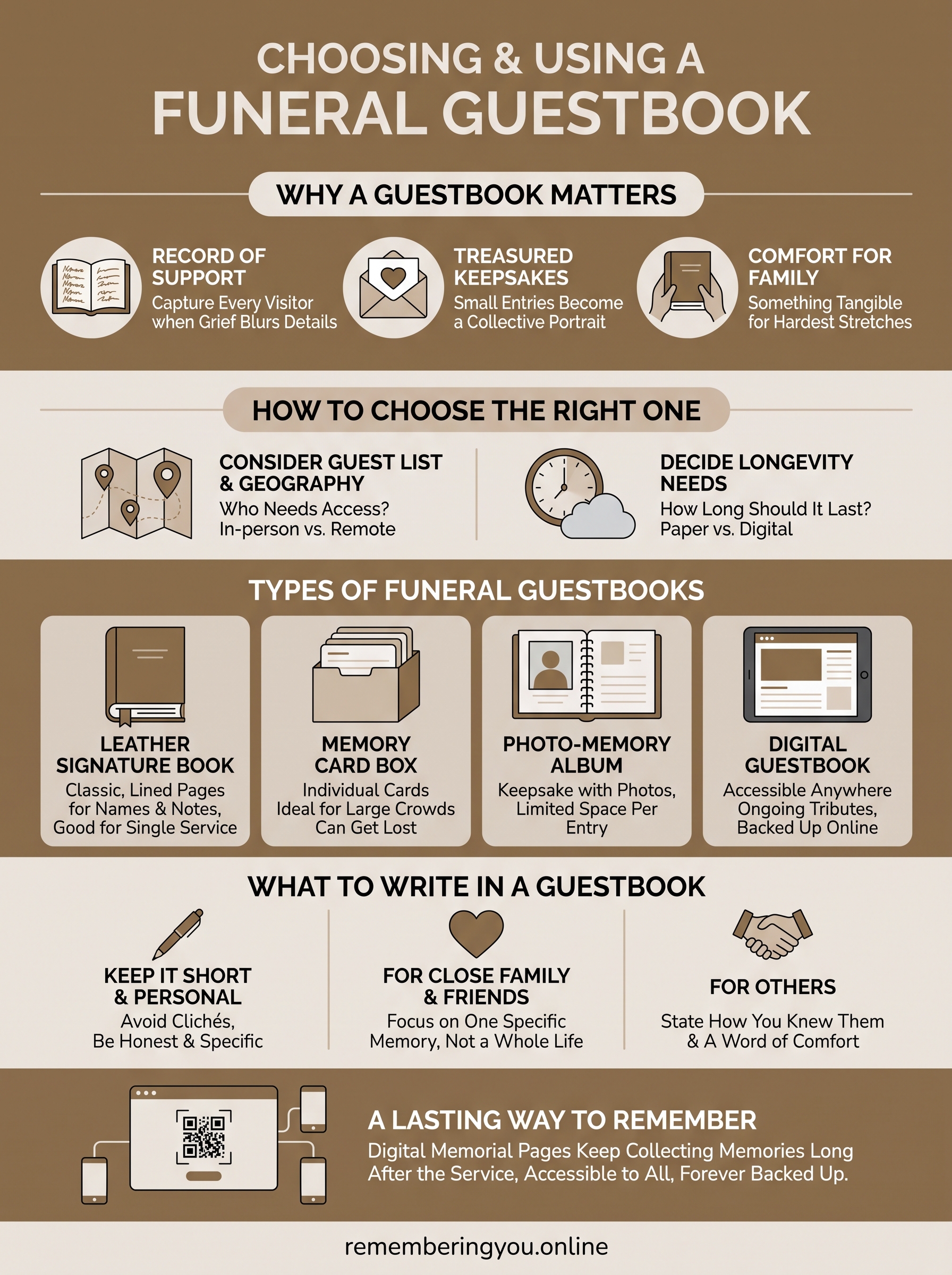
Funeral homes stock more than one style of book, and knowing the options before you walk in saves you from settling for whatever sits on the counter that day. Some families still prefer the classic leather-bound signature book with lined pages for names and short notes. Others choose a memory card box, where guests write on individual cards that get filed together, which works well for large services where a single book would run out of pages by noon.
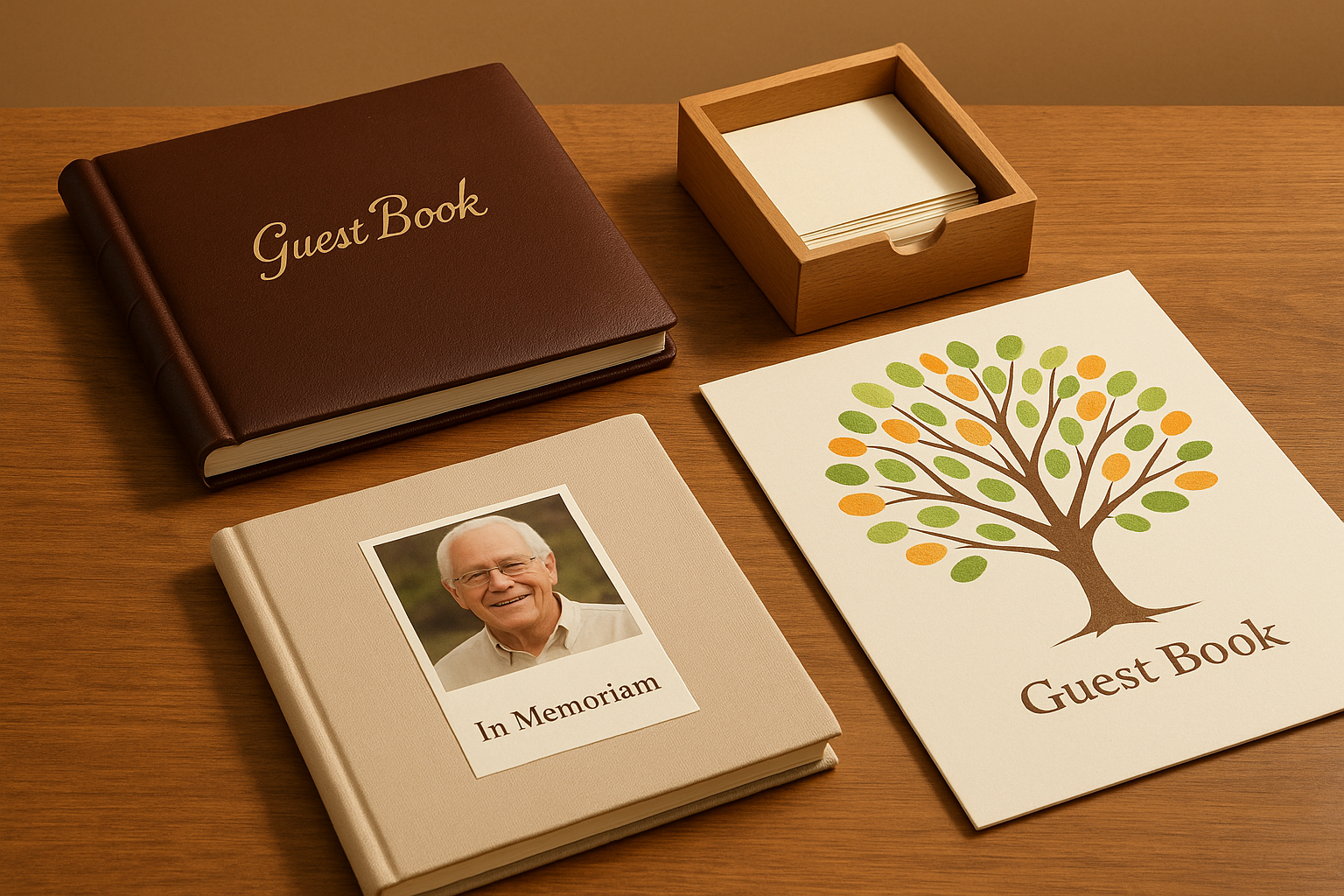
Albums built around a photo of the deceased on each page, with space beside it for a written memory, have grown popular too. These photo-guestbook hybrids double as a keepsake book families display at home rather than store in a drawer. A tree-shaped thumbprint guestbook, where guests add a fingerprint leaf and their name, has become a common alternative for services with children or younger relatives attending.
Digital guestbooks solve a problem none of the physical versions can: access after the service ends. A page hosted through a memorial site you can set up at no cost like Remembering You lets anyone with the link add a message weeks or years later, not just during the viewing hours.
The best guestbook format is whichever one still lets people add to it after the funeral is over.
| Type | Best for | Limitation |
|---|---|---|
| Leather signature book | Small, in-person services | No entries after the event |
| Memory card box | Large crowds, overflow signing | Cards can get lost or shuffled |
| Photo-memory album | Families wanting a keepsake to display | Limited space per entry |
| Digital guestbook | Dispersed families, ongoing tributes | Requires internet access to view |
Weigh these against your guest list and how long you want the record to grow before picking one off the shelf or online.
What to write in a funeral guest book
Staring at a blank page with a pen in hand stops more people than the drive to the service itself. Most guests freeze because they think they need something profound, when a few honest sentences do far more for the family than a rehearsed quote ever could. A guestbook for funeral service works best when entries stay personal rather than generic, so aim for a specific memory over a sympathy card cliché like "thinking of you," though sympathy message examples for condolence notes can help if the words won't come.
For close family and lifelong friends
Writing for someone you knew for decades means you have too much to say, not too little. Focus on one moment: the fishing trip, the recipe she taught you, the joke he told every Thanksgiving. Naming that single memory beats a paragraph of general praise, because specific details are exactly what grieving families reread months later.
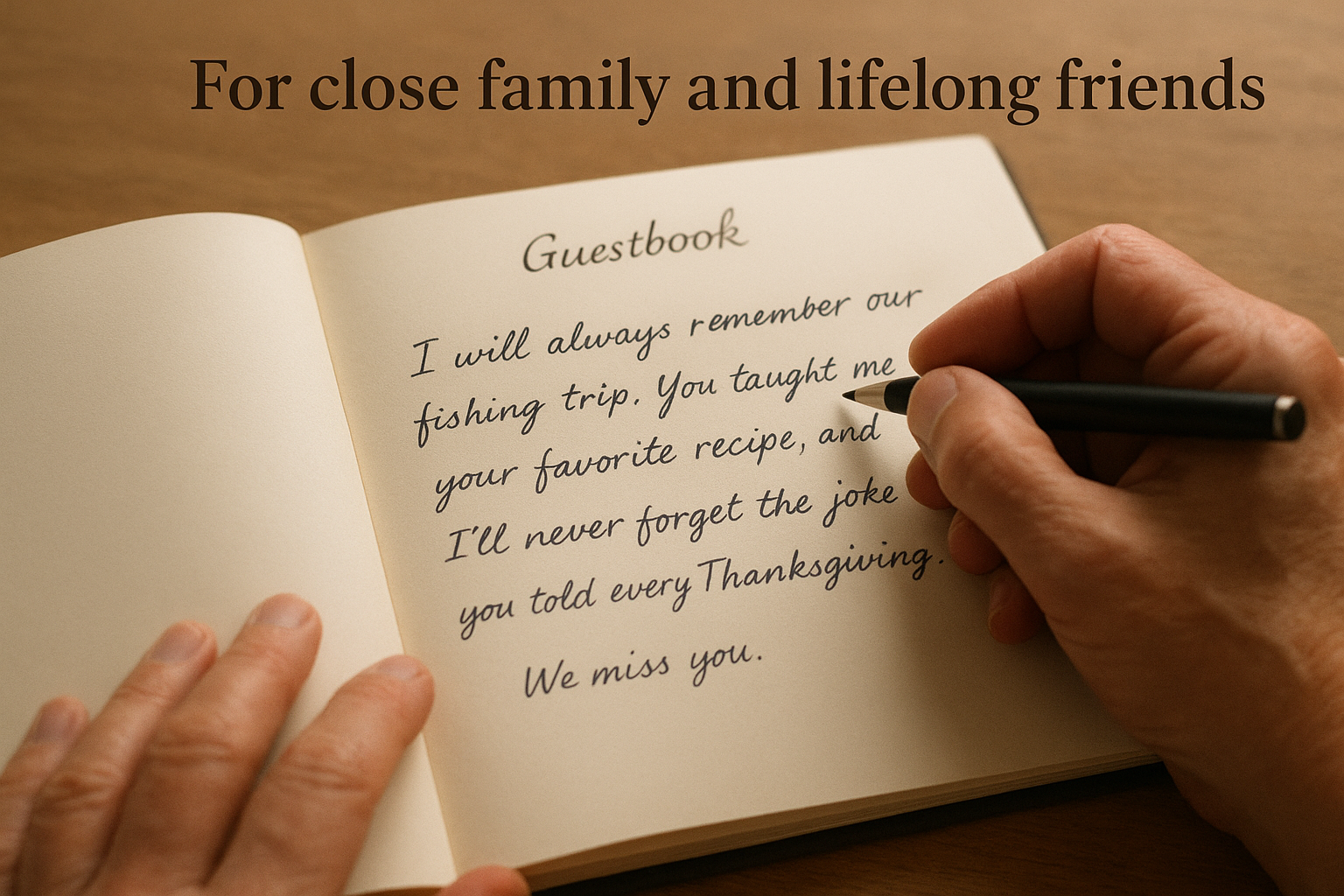
The best guestbook entry names one memory instead of describing a whole life.
For coworkers, neighbors, and distant relatives
Guests who knew the deceased less closely often worry their entry won't measure up, but showing up for someone after a loss rarely requires the perfect words. It doesn't need to. A short line about how you knew them, plus one word of comfort for the family, fills that role completely. Consider a simple structure:
- How you knew the deceased ("We worked together at the plant for twelve years.")
- One specific trait or memory ("He always had coffee ready before anyone else arrived.")
- A brief line of support ("Thinking of your family during this time.")
Keep it short, not clever
Overthinking the entry usually makes it worse. Two or three sentences read better on the page than a long story that stalls the line behind you. Rather than searching for perfect wording, write what you'd say if the person were standing in front of you, since that honesty is what makes a guestbook funeral page worth rereading years from now.
A lasting way to remember
Whatever style you land on, the point of a guestbook for funeral services stays the same: capture names and memories before they slip away. Paper works fine for a single afternoon, but a digital memorial page keeps growing long after the last guest signs out, which matters more once the initial shock of loss wears off and the real remembering begins.
Families who choose a lasting format rarely regret it, especially when relatives scattered across the country want to add their own words months later. A shared guestbook that anyone can reach from a phone beats a book sitting in a closet, and a QR code linking straight to it turns a headstone or memorial card into a doorway back to those messages.
If you want that option without spending anything upfront, start a free memorial guestbook online with Remembering You and give your family a place that keeps collecting memories for as long as they need it.