
10 Sympathy Card Messages for the Loss of a Father
You're staring at a blank card, pen in hand, and nothing sounds right. Losing a father hits differently than other losses, and finding words that feel genuine instead of generic is harder than it should be. If you're searching for sympathy card messages for loss of a father, you're probably worried about sounding hollow or accidentally saying the wrong thing to someone already in pain.
This article gives you exactly what you need: ready-to-use lines you can write as-is or adjust to fit your relationship with the grieving person. Whether you need something brief for a coworker's dad or a heartfelt message for a close friend who just lost their father, you'll find options that match the tone you're going for.
Below are 10 sympathy card messages for the loss of a father, covering everything from short condolences to more personal notes. We'll also touch on how these words can extend beyond the card itself. Many families now create an online memorial page for a father where friends and relatives can leave lasting messages of support, a fitting next step once the initial card has been sent.
1. Simple and sincere sympathy messages
Sometimes the kindest thing you can write is also the simplest. Short sympathy messages for loss of father work because they don't ask the grieving person to process anything complicated while they're already overwhelmed. A brief, sincere line acknowledges their pain without demanding an emotional response, and it tells them you're thinking of them without turning the card into a performance of grief you don't fully share.
The best sympathy message is the one that feels honest, not the one that sounds impressive.
When to use this message
Reach for a simple message when you don't know the deceased personally, when your relationship with the grieving person is more casual, or when you're simply unsure what else to say. These lines also work well as a starting point you can build on if you want to add a personal detail later, and a broader collection of sympathy messages for cards and condolence notes can give you more wording to draw from. A sympathy card for loss of father messages search often leads people here first, because short and sincere covers almost every situation without risking an awkward misstep. If you're writing to someone you don't know well, like a neighbor or a distant relative, simplicity keeps the message appropriate without overstepping.
Example messages you can copy
Use any of these as written, or tweak the wording slightly to match your own voice:
- "I'm so sorry for the loss of your father. Sending you strength and comfort during this difficult time."
- "Thinking of you and your family as you mourn the loss of your dad. He will be deeply missed."
- "My heart goes out to you. Your father's memory will live on in everyone who knew him."
- "With deepest sympathy on the passing of your father. I'm here if you need anything at all."
- "There are no perfect words for a loss like this. Just know I'm thinking of you and your family."
- "I'm holding you in my thoughts as you navigate this loss. Your dad meant so much to so many."
- "So sorry to hear about your father. Wishing you peace and comfort in the days ahead."
Each of these keeps the focus on the reader rather than on finding clever phrasing, which is exactly what a grieving person needs in the first days after a loss. Notice that none of them try to explain the loss or offer advice, they simply acknowledge it and offer presence. That restraint is what makes a short message land as sincere rather than dismissive.
2. Messages that celebrate cherished memories
A message that names something specific about the father you're honoring carries more weight than any generic phrase ever could. Messages that celebrate cherished memories shift the focus from loss itself to the life that was lived, and that shift often brings genuine comfort rather than fresh sorrow. If you knew the father personally, even briefly, mentioning a trait, a joke, or a moment you shared shows the grieving person that his impact reached beyond their own family.

When to use this message
Choose this approach when you actually knew the deceased and have a real memory to draw from, even a small one. Skip it if you never met him, since a fabricated memory reads as insincere the moment it's noticed. These examples of sympathy messages for loss of father work especially well for neighbors, family friends, or longtime coworkers who watched the father show up at birthdays, ballgames, or backyard barbecues over the years.
Example messages you can copy
Adapt these with your own detail if you have one:
- "I'll always remember your dad's laugh filling the room. He had a way of making everyone feel welcome."
- "Your father's kindness to our whole family over the years meant more than he probably knew. Sending love to you."
- "I still think about the stories your dad told at every gathering. What a gift it was to know him."
- "Your dad's generosity left a mark on everyone he met, including me. I'm so sorry for your loss."
Details like these tell the family their father's presence was noticed and valued outside their own home, which is often exactly what they need to hear.
3. Religious and faith-based sympathy messages
For families who find comfort in scripture or prayer, a message that reflects their beliefs can feel more meaningful than a purely secular one. Religious and faith-based sympathy messages draw on shared spiritual language to remind the grieving person that their father's life, and their loss, is held within something larger than the moment. These lines work especially well when you know the family attends church regularly or has spoken openly about their faith carrying them through hard times.
Faith-based words comfort best when they echo beliefs the reader already holds, not beliefs you're hoping to introduce.
When to use this message
Use this style only when you're confident the recipient shares your faith or a similar one. Many sample sympathy messages for loss of father searches come from people writing to devout families who would welcome scripture, a mention of heaven, or a note about praying for them. If you're unsure of someone's beliefs, a general phrase like "holding you in prayer" tends to be safer than quoting a specific verse. Skip this category entirely for recipients who aren't religious, since well-meaning scripture can feel out of place rather than comforting.
Example messages you can copy
These messages lean on common phrases found in Christian and Catholic sympathy cards, but feel free to swap in language from your own tradition:
- "Praying for peace and strength for you and your family during this difficult time."
- "May God's comfort surround you as you grieve the loss of your father."
- "Your father is now at rest in God's loving arms. Sending prayers to you and your family."
- "Holding onto the promise that he is now at peace, and holding you close in prayer."
- "May the peace that comes from God ease your heart in the days ahead."
Families who value this kind of message often continue that faith tradition afterward, adding a prayer intentions board or virtual candles to a memorial page where visitors leave prayers and tributes as another way to keep others praying alongside them.
4. Messages offering ongoing support and comfort
Grief doesn't end when the funeral does, and the hardest weeks often come after the flowers wilt and the visitors stop calling. Messages offering ongoing support and comfort go beyond the initial condolence by promising presence weeks or months down the road, when the person is more likely to actually need it. These lines work well because they give the grieving person something concrete to lean on later, rather than a one-time gesture that fades from memory.
A promise to check in next month often means more than any comfort offered today.
When to use this message
Write this way when you genuinely intend to follow through, whether that's a phone call in a few weeks or an open invitation to talk anytime, and it helps to know what truly helps a grieving friend or family member before you promise it. Close friends, neighbors, and coworkers who see the grieving person regularly are ideal recipients, since ongoing contact is realistic. Several sympathy card messages for loss of dad searches come from people who want to say more than "I'm sorry" but aren't sure how to offer real, lasting support without sounding vague.
Example messages you can copy
These options work as written or as a starting point for your own wording:
- "Please know I'm here for you, not just today but in the weeks ahead too."
- "Grief doesn't follow a schedule. I'm available whenever you need to talk, cry, or just sit quietly."
- "I'll be checking in on you, but please reach out anytime before then. You don't have to carry this alone."
- "Whatever you need in the coming months, whether it's a meal, a favor, or just company, I'm one call away."
5. Messages for close family members
When the person grieving is your sister, your brother, or your own mother who just lost her husband, generic condolences feel too distant for the closeness you share. Messages for close family members can afford to be longer and more personal, since you likely knew the father well yourself and share in the loss rather than just witnessing it. These notes often blend comfort for the reader with your own grief, which is appropriate here in a way it wouldn't be for a coworker's card.
Family grief is shared grief, so it's fine to let your card show that you're mourning too.
When to use this message
Save this tone for siblings, children, spouses, or close relatives who lost their own father, grandfather, or someone grieving the loss of a father-in-law. Nieces and nephews writing to an aunt or uncle can also use this style, since the loss touches the whole family tree. Unlike messages to acquaintances, these can reference private family details, inside jokes, or shared childhood memories without needing extra context, since the recipient lived those moments alongside you.
Example messages you can copy
Adjust the relationship term to match your own family:
- "There aren't words big enough for what Dad meant to all of us, but know I'm right here with you through this."
- "Losing him has left a hole in our whole family, and I'm so grateful we have each other to lean on."
- "Grandpa's love shaped every one of us. I'm thinking of you constantly and carrying his memory with me too."
- "We grew up watching Dad live out his values every single day. I'll miss him more than words can say, and I'm here for you always."
These messages work well as a starting point for a longer letter or a tribute you might later add to a private memorial page for the family, where relatives can contribute memories over time.
6. Messages for friends grieving a father
Friendship changes the tone of a sympathy message. Messages for friends grieving a father can be warmer and more casual than what you'd write to an acquaintance, since your friend already knows your voice and won't need formal phrasing to feel your sincerity. You can lean on the closeness you share and speak the way you actually talk to them, which often lands better than a stiffer, more traditional line.

A message that sounds like you is more comforting to a friend than one that sounds like a card.
When to use this message
Write this way for close friends, whether you knew their father personally or only through stories they've shared over the years. These sympathy messages for cards for loss of father work best when you skip the formal opening lines entirely and go straight to something personal, since your friend won't expect ceremony from you. If you're texting rather than mailing a card, this same tone translates easily, since the goal is comfort, not formality.
Example messages you can copy
Feel free to soften or adjust these based on how close you two are:
- "I don't have the right words, but I'm here for you, whatever you need, whenever you need it."
- "Your dad raised someone pretty incredible. I'm so sorry, and I love you."
- "Sending you the biggest hug right now. Call me anytime, day or night."
- "I know how much your dad meant to you. I'm not going anywhere, so lean on me."
A friend's card doesn't need to impress anyone, it just needs to feel true to the friendship you already have.
7. Messages for colleagues and acquaintances
Workplace relationships sit in an odd middle ground between formal and personal, which makes writing to a colleague harder than it should be. Messages for colleagues and acquaintances need to acknowledge real loss without overstepping a boundary that professional distance usually keeps in place. You're not trying to comfort them the way a close friend would, you're offering respectful support while staying within the bounds of a work relationship that may not extend beyond the office.
A respectful, brief message tells a colleague you care without pretending a closeness you don't share.
When to use this message
Reach for this tone with coworkers, clients, business contacts, or neighbors you're friendly with but don't know deeply. Many people searching for sympathy card messages for loss of father land here specifically because the workplace card gets passed around the office and everyone needs a line that feels sincere without sounding overly familiar. This category also works for acquaintances from clubs, gyms, or community groups where you share a passing connection rather than a close bond.
Example messages you can copy
These lines stay warm but appropriately measured:
- "I was sorry to hear about your father. Please accept my condolences during this difficult time."
- "Thinking of you at work and beyond. Take whatever time you need, we've got things covered here."
- "My condolences on the loss of your dad. Wishing you comfort and peace in the days ahead."
- "So sorry for your loss. If there's anything I can do to help lighten your workload, just say the word."
A short, respectful note like these often means more to a coworker than an elaborate one, since it respects the limits of the relationship while still showing genuine care.
8. Messages for a sudden or unexpected loss
A sudden death changes everything about how you write a sympathy card. Messages for a sudden or unexpected loss need to avoid phrases like "after a long battle" or "finally at peace," since those words assume a timeline that never existed here. Shock, not exhaustion, defines this kind of grief, and your message should reflect that the family had no chance to prepare, say goodbye, or brace themselves for what happened.
Sudden loss leaves no time to prepare, so your words should acknowledge the shock, not assume acceptance that hasn't happened yet.
When to use this message
Choose this approach for deaths from accidents, heart attacks, strokes, or any loss that arrived without warning. Avoid clichés about a father being "finally free of pain," since that language only fits illnesses the family watched unfold over time. Many people typing sympathy card messages for loss of father into a search bar land here first because they're struggling to find words for a loss that still feels unreal to everyone involved, including them.
Example messages you can copy
These lines acknowledge shock without offering explanations no one has yet:
- "I'm still in shock hearing about your father. There are no words for something this sudden and unfair."
- "My heart is breaking for you. None of us saw this coming, and I'm so deeply sorry."
- "I can't imagine how disorienting this must feel. I'm here for whatever you need right now."
- "This loss came without warning, and I know that makes it even harder. Sending you strength today and every day ahead."
Give the family room to process before expecting a reply, since shock often delays grief rather than easing it.
9. Messages that include a lasting tribute
Some sympathy cards do more than offer comfort in the moment, they point the grieving person toward something that outlasts the funeral flowers. Messages that include a lasting tribute suggest a way to keep a father's memory active, whether that's planting a tree, setting up a memorial fund for a cause he cared about, or creating a space where people can keep sharing memories long after the cards stop arriving. This category works well when you want your message to feel like the start of something rather than a closing line, especially if you can point to meaningful tribute ideas to honor a loved one.

A tribute that lasts gives grief somewhere to go, instead of leaving it to fade quietly.
When to use this message
Write this way when you want to give the family a next step, not just a kind sentence. It suits close friends and family members who plan to stay involved, and it works especially well if you're already thinking about contributing to a memorial yourself. Many families now set up a dedicated page on one of the best online memorial websites for a father soon after the funeral, and mentioning that in your card, or offering to help build one, gives your message practical weight instead of leaving comfort as an abstract idea.
Example messages you can copy
These lines work well alone or as an addition to a longer note:
- "I'd love to help put together a memorial page for your dad, so everyone who loved him can add their own memories."
- "Your father's story deserves to be told and retold. I hope we can find a lasting way to keep sharing it."
- "In honor of your dad, I made a donation to [cause]. His generosity inspired it."
- "Let's plant something in his memory this spring. His impact deserves to keep growing."
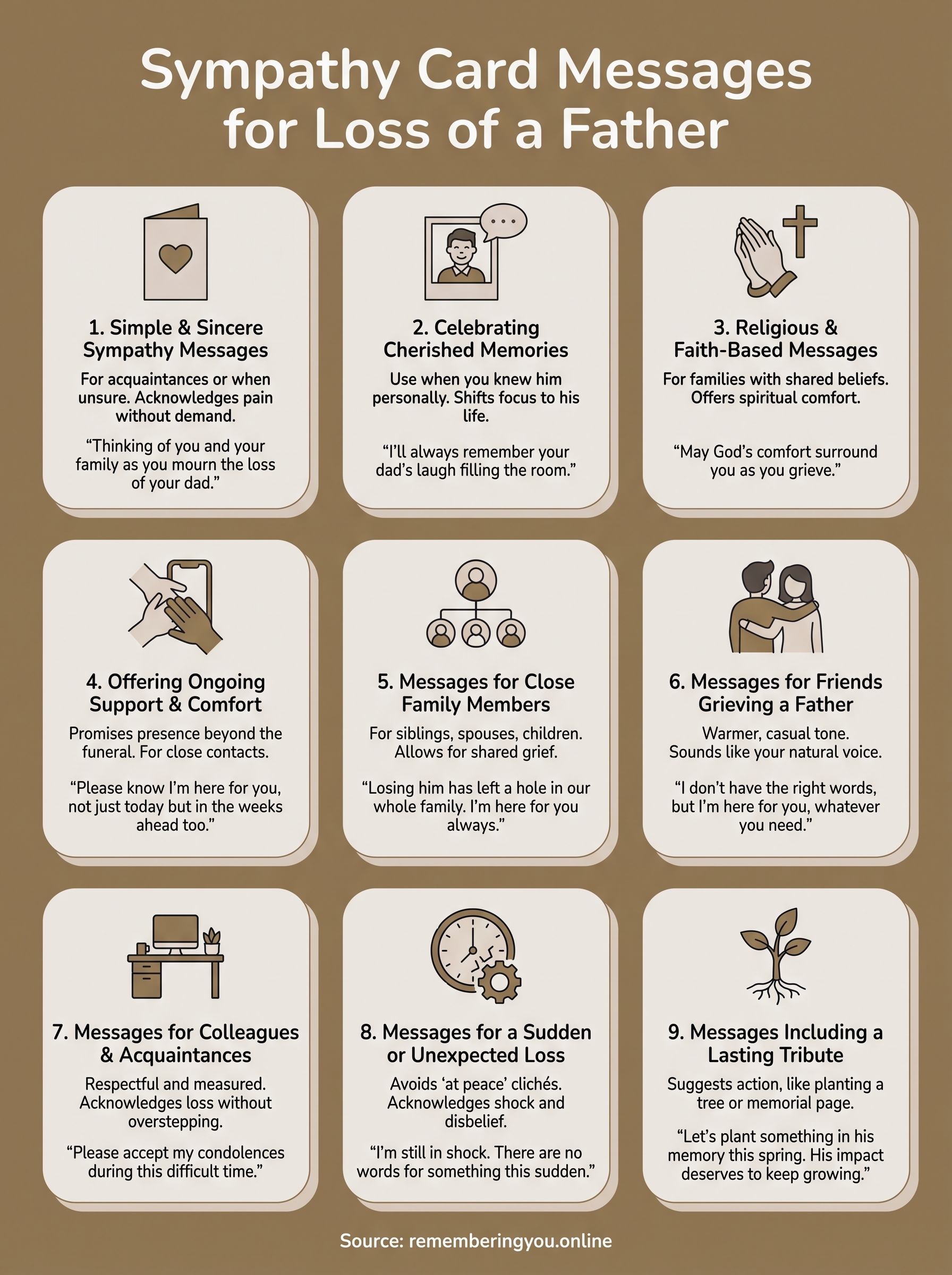
Choosing the words that comfort most
Writing a sympathy card doesn't require perfect prose, it just asks for honesty. Whether you picked a short sympathy message for a coworker or a longer tribute for a sibling, the words that land best are the ones that sound like you and acknowledge the father who's being mourned. Skim back through these examples whenever you're stuck, and don't be afraid to combine a few lines or add a personal detail that makes the message truly yours.
Grief doesn't stop when the card gets mailed, though. Families often want a place where those memories can keep gathering, long after the guestbook at the funeral home closes. If you're looking for a next step to suggest, or you're the one grieving and want somewhere lasting to gather stories, photos, and tributes from everyone who loved him, create a free digital memorial tribute page for your father and give his story a home that outlasts any single card.