
50 Sympathy Messages for Loss of a Mother
Finding the right words when someone loses their mother is hard. You want to say something meaningful, not a hollow phrase that sounds like every other card on the shelf. If you're staring at a blank sympathy card right now, searching for sympathy messages for loss of a mother that actually feel genuine, you're in the right place.
Below you'll find 50 sympathy card messages organized by tone and situation, from short and simple lines for a coworker to heartfelt notes for a close friend grieving her mom, and if you need wording for a different loss there are 60 more sympathy card messages for every kind of loss too. Whether you need sympathy messages for death of mother to write in a card today or words to say in person at a wake, you'll find something here that fits your relationship and feels honest rather than generic.
Once the card is signed and the service has passed, many families look for a way to keep their mother's memory somewhere lasting. That's where a digital memorial page comes in. At Remembering You, families create free tribute pages with photos, stories, and a shared memorial guestbook for family and friends where anyone who loved her can add their own memories, long after the sympathy cards get put away.
1. For a close friend or family member
When to use these messages
Close friends and family deserve more than a store-bought phrase. When you're writing loss of a mother sympathy messages for someone you actually know well, a niece, a best friend, a sibling, or a cousin, you can reference specific memories, her mother's personality, or the bond they shared. This is the category where you have room to be personal, even a little imperfect. Skip the formal distance you'd use for an acquaintance and write like you're sitting next to them, because that's essentially what the card is doing on your behalf.
Grief from someone this close to you calls for words that acknowledge the depth of the relationship, not just the fact of the loss. Mention her mother by name if you knew her. Bring up a memory, a laugh, a kindness she showed you. These small specifics are what separate a message someone reads once and sets aside from one they tape inside a drawer and reread for years.
The best sympathy message for a close friend names what was actually lost, not just that a loss occurred.
Example messages
Here are ten messages suited to someone you're close with, and if you'd rather borrow a line, there are also grief quotes about a mother that fit a card. Adjust the names and details to fit your relationship.
- "Your mom's warmth touched everyone who knew her, and I know that light will never fully go out. I'm here for you, day or night."
- "I don't have the right words, but I have all the time you need. Call me whenever, for whatever."
- "She raised someone I'm proud to call my friend. That alone tells me everything about the woman she was."
- "I keep thinking about how much she loved you, and how obvious that love was to everyone around her."
- "There's no fixing this kind of loss, but I can sit with you in it. I'm not going anywhere."
- "Your mom made me feel like family every time I visited. I'll carry that with me always."
- "I'm so sorry for the loss of your mother. She shaped so much of who you are, and that legacy doesn't disappear."
- "Whatever you need this week, groceries, a shoulder, silence, I'm one call away."
- "I remember her laugh so clearly. I'm holding onto that memory alongside you right now."
- "Losing a mother changes everything. I love you, and I'm grieving alongside you."
2. For a coworker or acquaintance
When to use these messages
Writing a sympathy card message for loss of mother to a coworker or acquaintance is a different exercise than writing to a close friend, and it helps to have sympathy wording written for condolence notes on hand. You want warmth without overreach. Someone you see at the office twice a week, or a neighbor you wave to but don't really know, doesn't need you to guess at the depth of their grief. They need a message that's respectful, professional in tone, and clearly sincere. Keep it brief. Long, emotional paragraphs from someone who isn't close can actually feel awkward rather than comforting.
Often this is the exact situation where people search for sympathy messages loss of mom wording, because they want to say something kind without overstepping a boundary that isn't theirs to cross. A simple card, or even a short message on a card someone else is passing around the office, is usually enough. Avoid inside jokes or assumptions about the relationship. Stick to acknowledging the loss and offering a small, concrete gesture of support if appropriate, since concrete ways to help someone after a loss tend to matter more than the words themselves.
With a coworker or acquaintance, brevity and sincerity matter more than depth.
Example messages
These six messages work well for office cards, group signatures, or a quick note to someone you know but aren't especially close with.
- "I was so sorry to hear about your mother. Thinking of you during this difficult time."
- "Please accept my deepest condolences. Take all the time you need."
- "Wishing you comfort and peace as you navigate this loss."
- "I'm thinking of you and your family. Let me know if there's anything I can help with at work."
- "So sorry for your loss. Your mother raised someone kind and hardworking."
- "Sending you strength during this hard time. We're all here for you."
3. From someone who has also lost their mother
When to use these messages
Sharing your own experience of losing a mother gives your words a kind of authority that sympathy alone can't offer. If you've been through this specific grief, you know the particular ache of it, the way it doesn't resemble other losses. These sympathy for loss of mother messages work best when you gently acknowledge that shared experience without turning the card into a story about yourself. The goal is to let the grieving person know they're not alone in a club nobody wants to join, not to redirect attention to your own loss.
Use this angle when you genuinely have lost your own mother, not as a generic technique. People can tell the difference between authentic solidarity and a borrowed line. A short mention that you understand, paired with an offer to talk whenever they're ready, tends to land harder than any generic phrase about being "there for them."
Grief shared from experience carries more weight than sympathy offered from a distance.
Example messages
These six messages work well when you've walked this same road and want to say so honestly.
- "I lost my mom five years ago, and I still think of her every day. That love doesn't go anywhere. I'm here if you ever want to talk."
- "Nobody prepares you for losing your mother. I remember how hard those first weeks were. Sending you so much love."
- "I know this particular grief. It reshapes you. Be gentle with yourself, and call me anytime."
- "When I lost my own mom, the smallest kindnesses helped most. I'm here for whatever that looks like for you."
- "This kind of loss never fully heals, but it does soften. I'm holding you close as you begin that process."
- "I've been where you are. It's brutal. You don't have to carry it alone."
4. For a sudden or unexpected loss
When to use these messages
A sudden death shatters the usual grief timeline. There's no chance to say goodbye, no warning that lets the mind brace for what's coming, and that absence of preparation makes the shock itself part of the wound. When you're writing sympathy messages for mom's death that came out of nowhere, an accident, a heart attack, a sudden illness, choose words that acknowledge the shock rather than pretending this loss unfolded the way losses usually do. Skip phrases like "after her long journey" or "finally at peace," since those assume an illness or decline that never happened here.
Unexpected loss also tends to bring a flood of people asking what happened, on top of everything a family has to handle in the first days after a death, which can exhaust someone who's already reeling. Your card doesn't need details or explanations. It just needs to say you're aware this hit without warning, and that you're not going anywhere while the shock wears off. A short note recognizing the suddenness of it often means more than a longer message that skips past that reality entirely.
Naming the shock of a sudden loss tells someone their disorientation makes sense.
Example messages
These six messages fit situations where the death was unexpected and the grief is still raw with disbelief.
- "I have no words for how sudden this was. I'm so sorry, and I'm here for you right now, today, and every day after."
- "There was no warning, no time to prepare, and that makes this so much harder. Sending you all my love."
- "I'm still in shock hearing this news, and I can't imagine how much harder it is for you. I'm here."
- "Nothing about this makes sense right now. Lean on me for whatever you need while it starts to."
- "Losing her so suddenly is a different kind of grief. Please let people help you through it."
- "I'm holding you close during this unimaginable, sudden loss. Call me anytime, day or night."
5. For a mother-in-law
When to use these messages

Writing sympathy messages loss of mother wording for a spouse's mom requires a specific touch, because the relationship sits somewhere between family and outsider. Even if you weren't especially close to your mother-in-law, your spouse was, and their grief deserves your full attention here. Recognize her role in your spouse's life and in your own family, whether she was a holiday host, a grandmother to your kids, or simply someone who welcomed you in. Avoid overstating a closeness you didn't have, but don't undersell how much this loss affects your partner either.
Often the hardest part is that you're grieving too, just less directly, while also needing to support your spouse through the heaviest version of this loss. A good card acknowledges both layers. Mention something true about her, a trait, a kindness, a memory involving your kids if she was a grandmother, and let your spouse know you're standing beside them through it.
A message to a mother-in-law should honor her role in the family, not just the fact that she's gone.
Example messages
These six messages work for a spouse's mother, whether your relationship was warm, formal, or somewhere in between.
- "Your mother welcomed me into this family from day one. I'll always be grateful for that, and I'm grieving with you."
- "She was such a wonderful grandmother to our kids. That love isn't something they'll forget."
- "I know how much your mom meant to you, and I'm here to support you through every part of this."
- "Watching you grieve your mother is breaking my heart too. I love you, and I'm not going anywhere."
- "Your mom's kindness shaped this family in ways we'll carry forward. So sorry for this loss."
- "She raised the person I married. I'm forever thankful, and forever sorry she's gone."
6. Religious and faith-based messages
When to use these messages

Faith often becomes the main language a family reaches for when grief arrives. For Catholic and Christian families especially, sympathy card messages for loss of a mother that reference grief scripture for a sympathy card, prayer, or heaven can offer real comfort rather than empty comfort. Use this angle when you know the grieving person shares your faith, or when their own family leans heavily on religious tradition during hard times. A line about her mother being "at peace with the Lord" lands well in a devout household and can feel jarring or presumptuous in one that isn't.
Gauge the family before you write. If you're unsure of their beliefs, a softer phrase like "holding you in prayer" works across most Christian traditions without assuming specifics about heaven or an afterlife. Many families also welcome an offer to light a candle for her in person or online or say a rosary in her memory, gestures that carry weight beyond the words themselves.
Faith-based sympathy messages comfort best when you know the family actually shares that faith.
Example messages
These six messages suit families who find comfort in prayer, scripture, or the promise of reunion.
- "May God's peace surround you and your family during this loss. Your mother is resting in His arms now."
- "Holding you in prayer as you grieve your mother. She is at peace, and so will you be, in time."
- "'Blessed are those who mourn, for they will be comforted.' Praying that comfort finds you soon."
- "I lit a candle for your mother last night. She's with the Lord now, and with you always."
- "Trusting that your mother has found eternal peace, and praying that same peace reaches your heart."
- "Your mom's faith guided so many. I know she's home now, watching over your family still."
7. For a complicated relationship with her mother
When to use these messages
Not every daughter or son had an easy bond with their mother, and grief doesn't wait for that relationship to be resolved. Someone mourning a mother she was estranged from, or one who caused real harm, still feels loss, just a tangled version of it that mixes relief, anger, sadness, and guilt all at once. When you're searching for loss mother sympathy messages for this exact situation, avoid phrases that assume a warm, uncomplicated bond, things like "she was your best friend" or "you were so close." Those lines can sting rather than soothe if they weren't true.
Instead, aim for language that honors the complexity without pretending it wasn't there. You don't need to know the details of the relationship to write something respectful. Focus on the person in front of you rather than the mother herself, and give them room to grieve however that actually looks for them, whether that's quiet sadness or something messier.
A complicated relationship deserves a message that doesn't force a simple story onto it.
Example messages
These six messages avoid assuming closeness and instead make space for whatever the grieving person is actually feeling.
- "I know your relationship with your mother wasn't simple. However you're feeling right now, that's valid, and I'm here for you."
- "Grief doesn't require a perfect relationship. I'm thinking of you as you sort through everything this loss brings up."
- "There's no one right way to grieve a complicated parent. Take whatever space and time you need."
- "I'm not going to pretend I understand everything you're feeling, but I'm here to listen if you want to talk."
- "Whatever this loss stirs up for you, anger, sadness, relief, all of it, I'm holding space for you."
- "You don't owe anyone a tidy story about your mother right now. I'm just here for you."
8. Short messages for cards and texts
When to use these messages
Sometimes you don't have room for a paragraph, or the moment calls for something quick and quiet instead. A text message the night you hear the news, a line in a group card at work, or a note tucked into flowers all call for short sympathy messages rather than a full letter. Brevity isn't a lesser option here. A single honest sentence sent within hours of hearing the news often means more than a long message that arrives a week later. These work well anywhere space is tight, including the small card attached to flowers or a sympathy card message for loss of a mother that needs to fit on a single line.
Texting also has its own etiquette. Skip emojis unless you know the person well enough that a heart or a dove feels natural rather than flippant. Send it once, don't expect a reply, and follow up with a call or visit later if you're close to them. The goal of a short message isn't to say everything, it's to say something true immediately.
A short message sent right away often comforts more than a long one sent late.
Example messages
These six lines work as texts, quick cards, or notes attached to flowers.
- "So sorry for your loss. Thinking of you."
- "My deepest condolences. Sending love."
- "I'm so sorry about your mom. Here for you."
- "No words, just love. I'm so sorry."
- "Sending you strength and comfort right now."
- "Thinking of you and your mom's beautiful memory today."
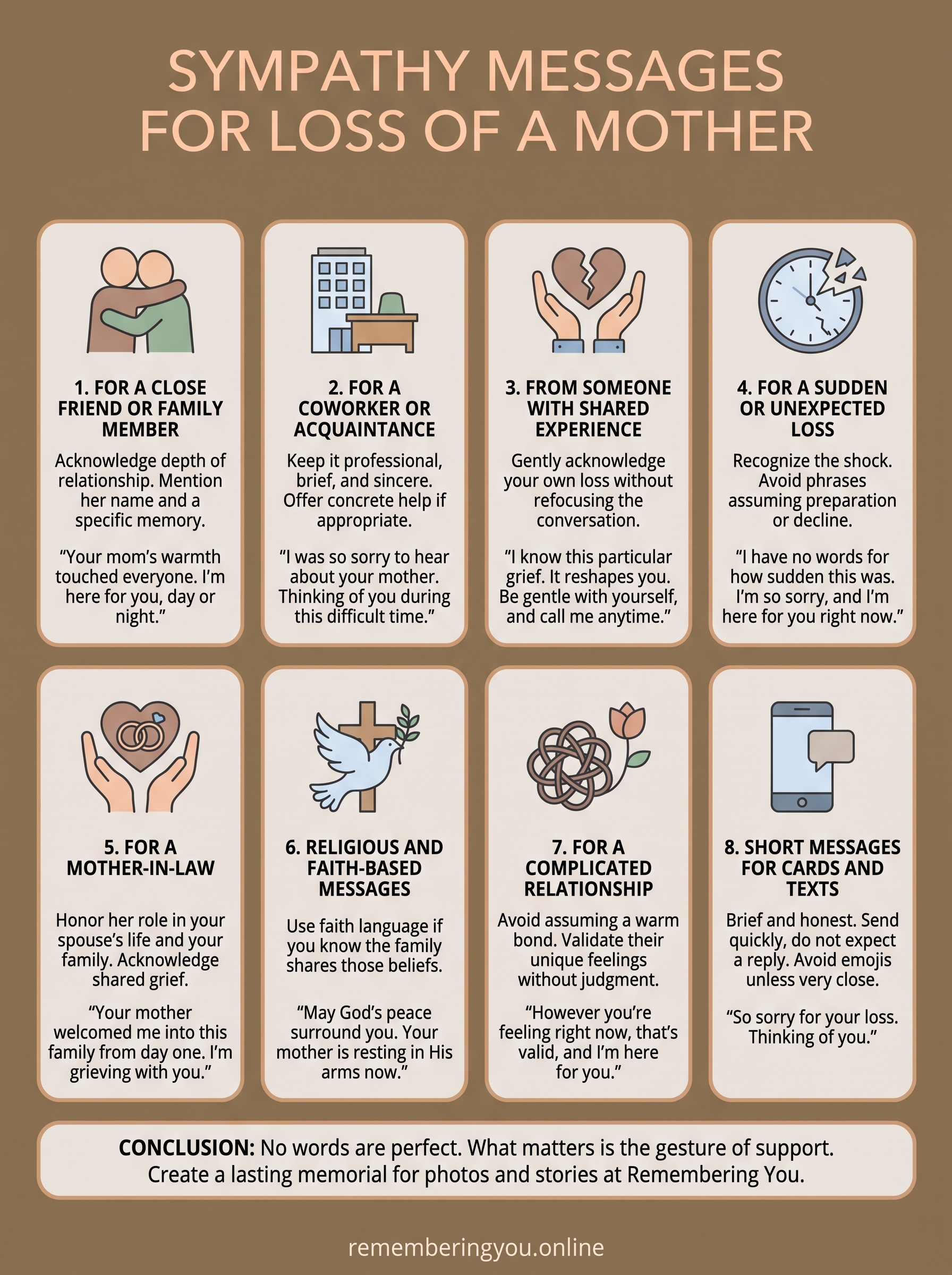
Finding the right words to offer comfort
No card or text ever fully captures what someone loses when their mother dies. What matters is that you tried, that you picked up the pen or opened the message app instead of staying silent because you weren't sure what to say. Pick whichever message above actually sounds like you, tweak the wording, add her name, and send it. Sympathy messages for loss of a mother don't need to be perfect. They need to be sent.
Once the immediate grief settles and the cards stop arriving, families often want somewhere lasting to hold her story, the photos, the memories, the small details a sympathy card can't fit. That's exactly what a free tribute page gives you. Create a free memorial page for her photos, stories, and guestbook in minutes at Remembering You, where anyone who loved her can add their own memory long after the funeral flowers are gone.