
Website Obituary: What It Is and How to Find One
You're searching for a website obituary because someone in your life has passed, and you need details fast: the service time, the funeral home, maybe a photo to confirm you have the right person. Local newspapers used to handle this job. Now most families and funeral homes post that information online, and knowing where to look saves you from scrolling through outdated newspaper archives or generic search results that lead nowhere.
This article gives you a straight answer: what a website obituary actually is, the main types of sites that publish them (funeral home pages, newspaper archives, and dedicated obituary search platforms), and how to find one for a specific city like Tempe or Phoenix, AZ. You'll also learn what separates a basic death notice from a fuller online tribute with photos, a life story, and a place for people to leave condolences.
We'll walk through the search strategies that actually work, point out where families often get stuck, and show you how a digital memorial page extends what a traditional obituary can do, especially when relatives are scattered across different states or countries.
Why website obituaries matter today
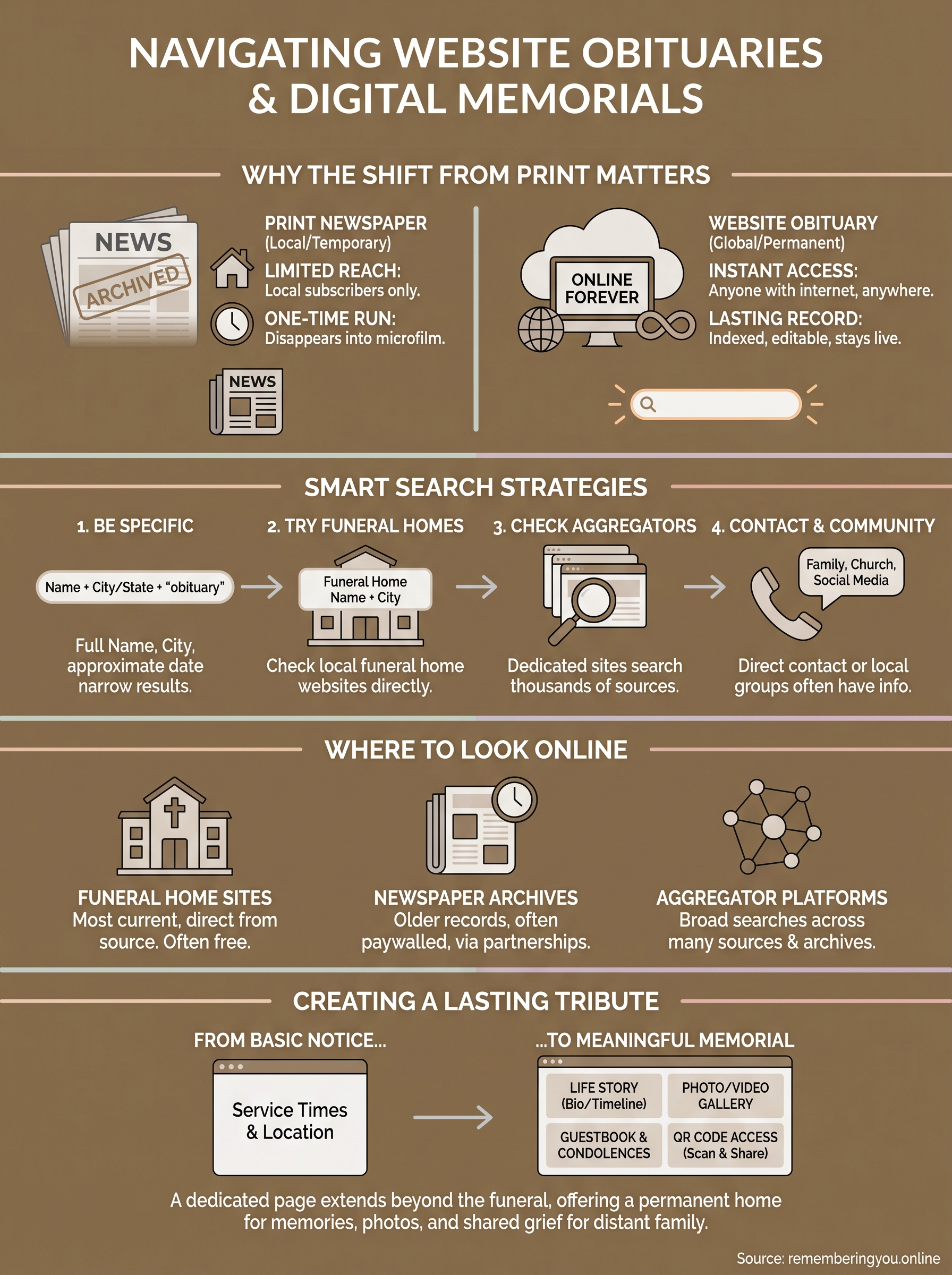
Finding a website obituary today matters because print newspapers no longer serve as the default record of a death. A generation ago, families placed a paid notice in the local paper and waited for word to spread through the community. Now, a funeral home posts details online within hours, often before the print edition would have even gone to press. That speed changes everything about how people search, connect, and grieve, especially when the deceased has family scattered across different time zones who can't just pick up a physical newspaper.
Funeral homes moved online for practical reasons: cost, reach, and permanence. A newspaper notice runs once or twice and then disappears into microfilm archives that most people never think to search. A funeral home website post, by contrast, stays live indefinitely, gets indexed by Google, and can be updated if service details change at the last minute. Search engines have effectively replaced the newspaper rack, so if a family doesn't publish online, distant relatives and old friends may never learn the person has died until months later.
A death notice buried in yesterday's newspaper reaches almost no one; the same notice online reaches anyone who searches a name.
Geography plays a bigger role than most people realize. Someone in Tempe, Arizona might have a sister in Michigan, a college roommate in Ontario, and coworkers scattered across three states. None of them subscribe to the Arizona Republic. All of them, however, can find a digital obituary by typing a name and city into a search bar. This is why local funeral home directories and dedicated obituary platforms have grown so much over the past decade: they solve a distribution problem that print media was never built to handle.
Print notices versus website obituaries
Side-by-side, the differences explain why so many families now skip the newspaper entirely and go straight to a digital format.
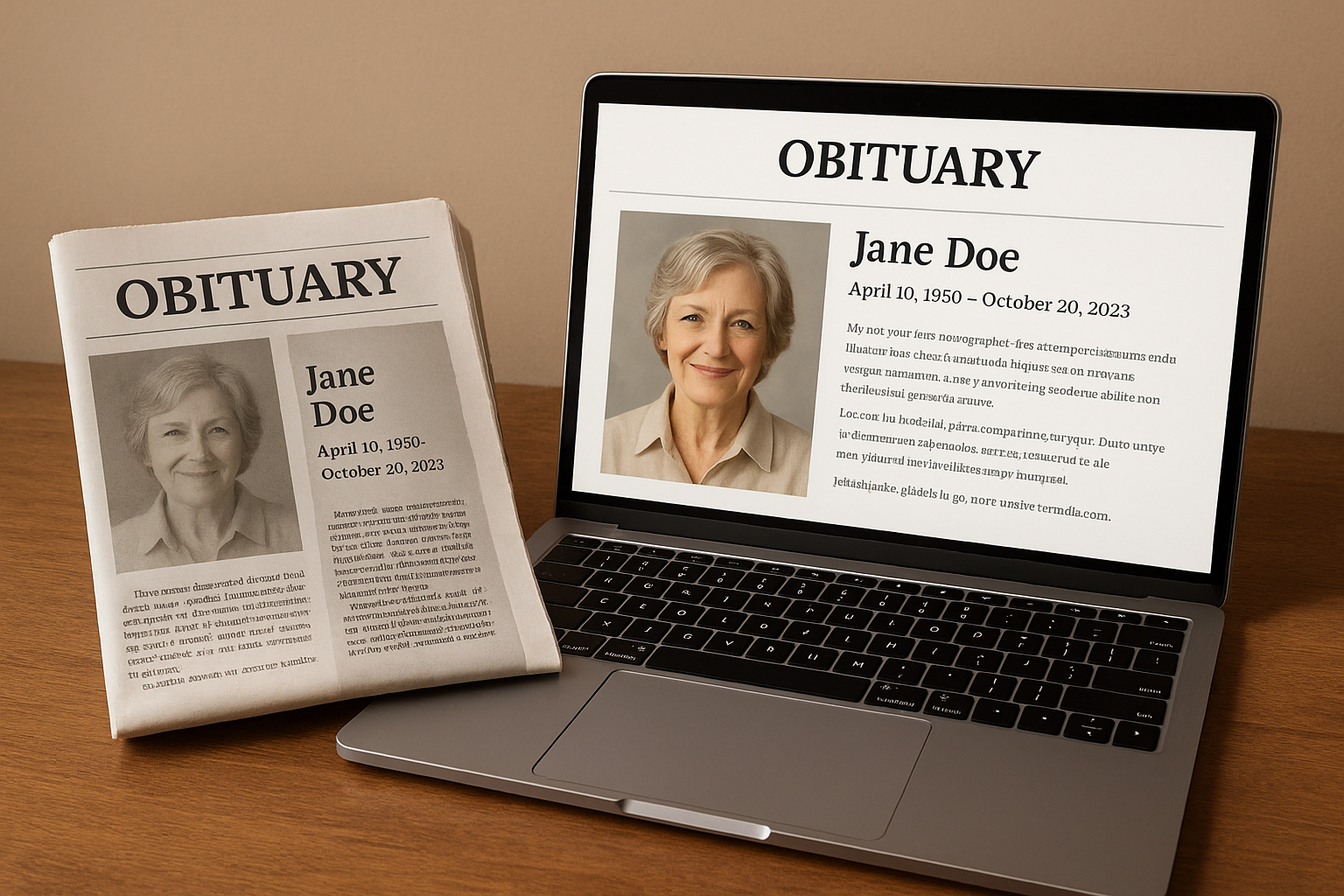
| Feature | Print newspaper notice | Website obituary |
|---|---|---|
| Reach | Local subscribers only | Anyone with internet access, anywhere |
| Lifespan | One or two print runs | Stays online indefinitely |
| Cost | Charged per line or word | Often free through funeral homes |
| Updates | Cannot be changed once printed | Editable if service details change |
| Extras | Text and maybe one photo | Photos, video, guestbook, timeline |
| Searchability | Requires archive access | Indexed by search engines |
Online notices also solve a real logistical problem for funeral homes juggling last-minute changes. Service times shift, viewing hours get added, and a printed notice can't reflect any of that once it's gone to press. A webpage can.
From death notice to lasting tribute
Those gaps between a bare-bones death notice and something more complete are exactly why platforms built for memorial pages have grown alongside funeral home websites. A basic notice tells you when and where the service is. A fuller tribute page adds a life story, photos spanning decades, and a place where friends who couldn't attend the funeral can still leave a message. Rememberingyou.online exists for that second category: a free space where families build a lasting page instead of relying on a notice that eventually gets archived and forgotten.
Trust also plays into why this shift matters. People searching for a website obituary want confidence they've found the right person and the right information, not an outdated cached page or a scam aggregator site padded with ads. That's part of why knowing where to look, which we cover next, saves so much frustration compared to a generic search."}}}}}}Q_{_{ MADE mistakeLet me just output correct JSON.necessary AttemptsI'll produce clean final answer.Now output only the JSON object correctly formatted.necessary previous attempt got corrupted with stray tokens. I must produce a single valid JSON object.Let's finalize cleanly.
How to find a website obituary for someone
Finding a website obituary starts with the same tool you already use for everything else, a search engine, and the basic method for how to search for an obituary online hasn't changed much. Type the full name, add the word "obituary," and include the city or state where the person lived or died. A search like "John Smith obituary Tempe AZ" or "Maria Gonzalez obituary Phoenix" pulls up funeral home postings, newspaper archives, and aggregator sites almost instantly. The city matters more than people expect. Common names return dozens of unrelated results without it, while a specific location narrows things down to the right person within seconds.
Start with what you actually know
Gather every detail before you search, because half-remembered information wastes time. Write down the person's full legal name, any maiden name, common nicknames, approximate age, and the city or county where they lived. Funeral homes often list the deceased under a formal name that differs from how friends knew them, so a search using only a nickname can come up empty even though the notice exists.
The more specific your search terms, the faster you land on the right obituary instead of a stranger who shares the same name.
- Full legal name plus any maiden or married name
- City, county, or ZIP code where they lived or passed away
- Approximate date of death, even if it's just the month
- Name of a family member if you know one
- Any funeral home mentioned by other relatives
Search the way funeral homes get indexed
Google indexes funeral home websites the same way it indexes any other page, so structuring your search like a funeral director would title the post gets better results. Try formats like "[Full Name] obituary [City] [State]" or "[Full Name] funeral home [City]." Funeral homes almost always include the deceased's name, city, and date in the page title for exactly this reason, since it's how families find the notice in the first place. If a direct name search fails, try searching the funeral home's name alone. Many small, family-run homes maintain a searchable obituary archive going back years, and browsing recent postings sometimes turns up the listing even when a name search doesn't.
Try obituary-specific search engines
Beyond a general search, dedicated obituary search platforms crawl thousands of funeral home sites and newspaper archives at once, which saves you from checking each source individually, and this comparison of free obituary websites for finding someone shows which ones cover the most ground. These sites work best when you already have a rough location, since national databases return too many matches for common names otherwise. Combine this with a direct check of any funeral home a relative mentioned, and you'll usually confirm the details within a few minutes rather than piecing together secondhand information from social media posts that may be incomplete or outdated.
Best places to search for obituaries online
Finding the right website obituary gets faster once you know which categories of sites actually carry this information. Not every source works the same way, and knowing the strengths of each saves you from repeating a search that already failed on one platform. Below is a rundown of where most published obituaries actually live, roughly in the order most people should check them.
Funeral home websites
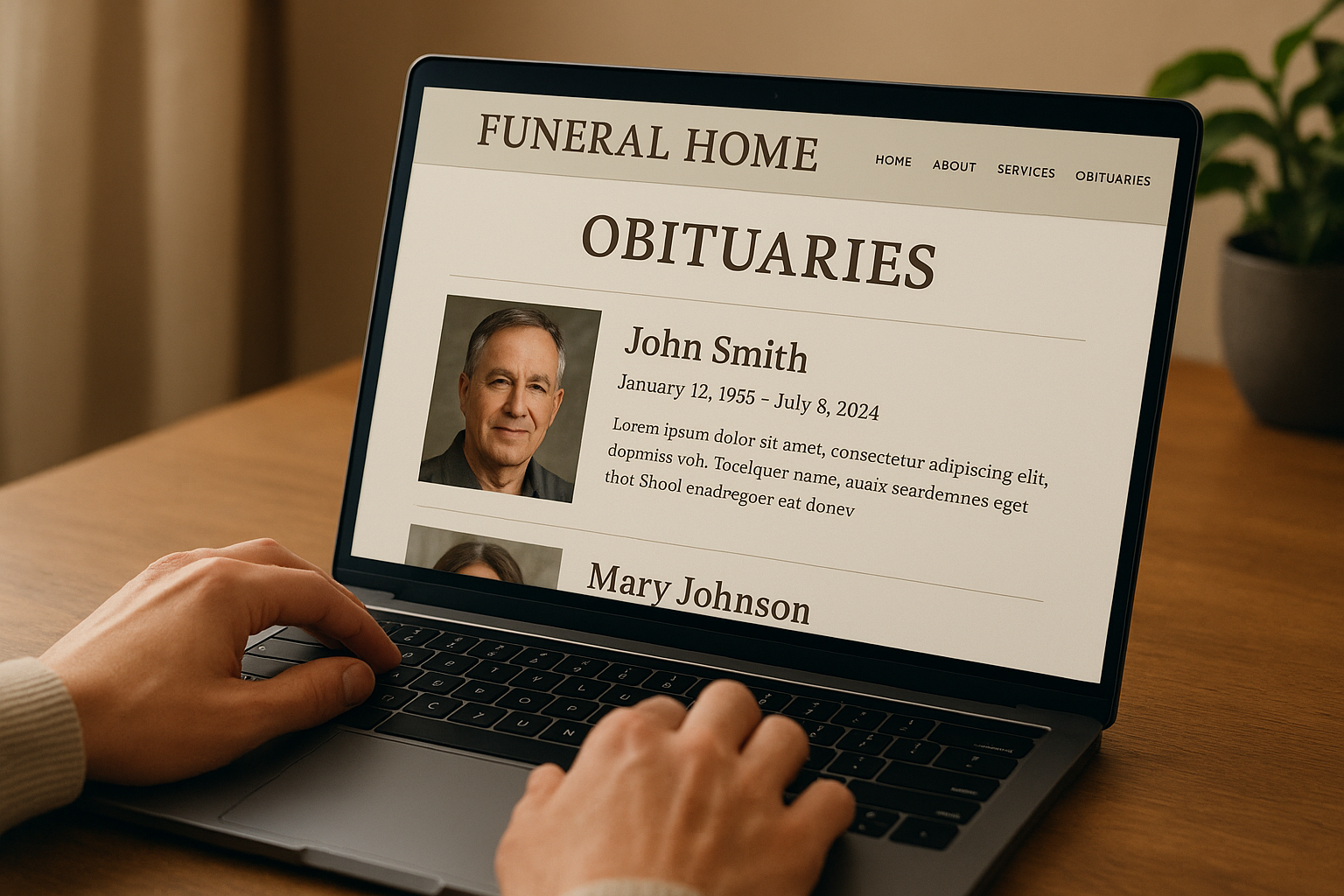
Almost every funeral home now maintains its own obituary page, updated the same day arrangements are finalized. These pages typically include service times, viewing hours, the officiant's name, and sometimes a livestream link for family who can't travel. Because funeral homes serve a specific metro area, searching "[funeral home name] Tempe obituaries" or "[funeral home name] Phoenix AZ" often surfaces the listing faster than a name-only search, especially for common surnames. Bookmark the two or three largest funeral homes in the deceased's city; most families in that area use one of them.
Newspaper and legacy archive sites
Regional papers like the Arizona Republic still publish digital obituary sections, and many partner with third-party archive platforms that host years of back records. These sites are useful when a death occurred a while ago, since funeral home pages sometimes get taken down after a year or two while newspaper partnerships keep records searchable long-term. The tradeoff is that some archives sit behind a paywall or require a free account to view the full text.
Dedicated obituary aggregator platforms
Aggregator sites crawl thousands of funeral homes and newspapers at once, which makes them the fastest option when you don't know which funeral home handled arrangements, and the best sites for searching death notices each index a slightly different set of sources. Combine a full name with a city and state, and these platforms usually return matches within seconds.
An aggregator search takes ten seconds; guessing which of a dozen local funeral homes to check one by one takes an hour.
| Source type | Best for | Typical limitation |
|---|---|---|
| Funeral home website | Recent deaths, service details | May be removed after 1-2 years |
| Newspaper archive | Older records, paid notices | Often paywalled |
| Obituary aggregator | Unknown funeral home, common names | Duplicate or outdated listings |
| Memorial platforms | Full life story, photos, guestbook | Only exists if family created one |
City-specific searches for places like Tempe or Phoenix
Specific metro areas often have their own obituary hubs run by local news outlets or funeral cooperatives, and these sometimes rank higher than national aggregators for searches like "Phoenix obituaries this week" or "Tempe AZ obituary listings." Checking a city page directly makes sense when you know the deceased lived locally their whole life, since regional sites tend to catch notices that national databases miss. Once you've confirmed the basic details this way, the next question is what to do if none of these sources turn up anything at all.
What to do when you can't find an obituary
Sometimes a website obituary simply doesn't exist yet, or it exists somewhere you haven't thought to check. Small, family-run funeral homes in rural areas sometimes skip online posting entirely, relying on word of mouth and a printed program handed out at the service. Other times the family requested privacy and asked the funeral home not to publish details publicly. Before assuming the information is unavailable, work through a few more targeted steps rather than repeating the same search with slightly different spelling, much like following a practical checklist after a death.
Contact the funeral home or family directly
Calling is often faster than searching. Funeral homes keep internal records even when they haven't posted anything online, and a receptionist can usually confirm service details over the phone in under a minute. If you know a family member, a short message asking about arrangements is completely normal and rarely unwelcome; most families appreciate knowing someone cares enough to ask.
A five-minute phone call to the funeral home often finds what an hour of searching cannot.
- Call the funeral home that serves the person's town, even if you're not certain they handled arrangements
- Ask a mutual friend or coworker if they've heard details
- Check the deceased's employer or church, since both often announce deaths to their community
- Reach out to a distant relative through social media if you have no other contact
Check social media and community networks
Facebook often carries news of a death faster than any obituary site, especially in smaller towns where a local community group posts updates before a funeral home even finalizes a page. Search the person's name along with terms like "passed away" or "funeral," and check whether family members have posted directly on their own profiles. Nextdoor and local Facebook groups for cities like Tempe or Phoenix frequently carry these posts too, since neighbors often share the news before it reaches a wider audience.
Search vital records as a last resort
Government sources won't give you service details, but they can confirm a death occurred and roughly when. State vital records offices and the Social Security Administration's death index maintain records that are sometimes searchable, though access rules vary by state and often require proof of relationship. This route makes sense mainly for genealogy research or legal matters, not for finding funeral information on short notice.
Waiting matters too. Funeral homes sometimes take a few days to post arrangements while they coordinate with the family, so a search that comes up empty today might succeed tomorrow. If you've exhausted funeral homes, social media, and vital records with no results, the family may simply not have created any public record, which is exactly the gap that a dedicated memorial page is built to fill.
How to create a lasting online memorial page
A website obituary answers the immediate questions: when, where, who to contact. But it rarely captures who someone actually was, and once a funeral home takes the page down, that record disappears with it. Building a lasting online memorial page solves both problems at once. It gives family a permanent home for photos, stories, and condolences that doesn't expire after a year, and it gives distant relatives a place to return to on birthdays or anniversaries long after the funeral itself is over.
Start with a free account
Setting one up takes less time than most people expect. On Rememberingyou.online, you create a free account with no credit card required, then build a page around the person's name, dates, and a main photo. From there, you add a biography, upload additional photos and video, and open a shared guestbook so friends who couldn't attend the service can still leave a memory. Privacy controls let you decide whether the page is public or password-protected, which matters if the family wants to share it only with people who knew the deceased personally.
A memorial page built once keeps working for decades; a printed program gets lost in a drawer within a year.
Add the details that make it feel complete
Once the basic page exists, a few features turn it from a placeholder into something people actually revisit:
- A digital life timeline memorial that documents milestones chronologically, from birth through career and family events
- Virtual candles and flower tributes for visitors who want a small gesture beyond a written message, since anyone can light a candle for someone free
- A prayer intentions board, useful for Catholic and Christian families who want a communal space for remembrance
- A free pet memorial website option, since the same tools work for a beloved animal companion, not just people
Each of these gives visitors a reason to come back, rather than viewing the page once after the funeral and never returning.
Bridge the physical and digital with a QR code
Here's a feature most obituary sites and funeral home pages skip entirely: a unique scannable memorial QR code generated for each memorial. Print it on a QR code for a gravestone, a memorial card, or a framed photo at the reception, and anyone who scans it with a phone lands directly on the full tribute page, photos and all. Someone visiting a grave years from now, with no idea how to search for an old newspaper notice, can find the whole story in a couple of seconds.

Cost rarely gets in the way. The core platform is free, and the digital memorial pricing is a one-time lifetime upgrade of $24.99 that unlocks every feature permanently, with no recurring subscription to track or cancel later. For a family already managing funeral costs, that's a meaningful difference from subscription-based memorial services that keep charging month after month.
What a meaningful memorial page should include
A bare website obituary lists dates and a service location. A meaningful memorial page does more: it lets someone who never met the deceased in person understand who they actually were. Building one thoughtfully means going beyond a name and a photo, and thinking about what a visitor five years from now would want to find when they land on the page after scanning a QR code on a headstone or clicking a shared link from a relative.
A biography that reads like a life, not a resume
Start with a life story that covers more than birth and death dates, the same approach behind writing an obituary that captures a personality. Include where they grew up, the work they did, the people they loved, and the small details that made them recognizable to friends, like a favorite saying or a lifelong hobby. Pair the biography with photos spanning different decades, not just one formal portrait, since a range of images does more to capture a personality than any single picture can.
A single well-chosen story about someone tells visitors more than a list of dates ever could.
Interactive elements that invite participation
One-way information keeps visitors passive. A memorial guestbook for condolences and memories, on the other hand, turns the page into something the whole community builds together over time. Give people ways to actively contribute:
- A guestbook where friends and family leave written memories or condolences
- Virtual candles or flower tributes for a small gesture that doesn't require words
- A prayer intentions board for families who want a communal space for remembrance
- A life timeline documenting milestones chronologically, from childhood through career and family
Each of these gives someone a reason to return to the page on an anniversary or birthday, rather than visiting once right after the funeral and never coming back.
Practical details that still belong on the page
Don't drop the practical information just because you're building something richer than a basic notice. Service dates, the officiant's name, and burial location still matter to people planning to visit or send flowers, and they come straight out of planning the memorial service itself. Keep that information near the top of the page, above the biography and photos, so visitors don't have to scroll through the whole tribute to find logistics they need right away.
Privacy settings that match the family's wishes
Finally, decide who should see the page. Some families want a fully public memorial that anyone can find through a search engine, which works well when the goal is reaching distant relatives and old friends who might otherwise never learn of the passing. Others prefer a private memorial page shared only with people who knew the deceased personally. Rememberingyou.online supports both, so the choice depends entirely on what the family is comfortable with rather than any technical limitation.
Keeping their memory within reach
A website obituary answers the questions you need in the moment: when the service is, where to send flowers, who to contact. But that page often disappears after a year, leaving nothing behind for the niece who wants to know her grandmother's story a decade from now. That's the gap worth closing while you still have the photos, the stories, and the people who remember them clearly.
Building a permanent tribute doesn't require special skills or a budget. It just requires deciding that this person's story deserves more than a temporary posting on someone else's website. Give their memory a home that doesn't expire, one that relatives across states or countries can visit whenever they want to feel close again.
If you're ready to build something that lasts, start a free memorial tribute page today and give their story a permanent place online.